Yimei New Material-Professional Wax Product Solution Supplier


-
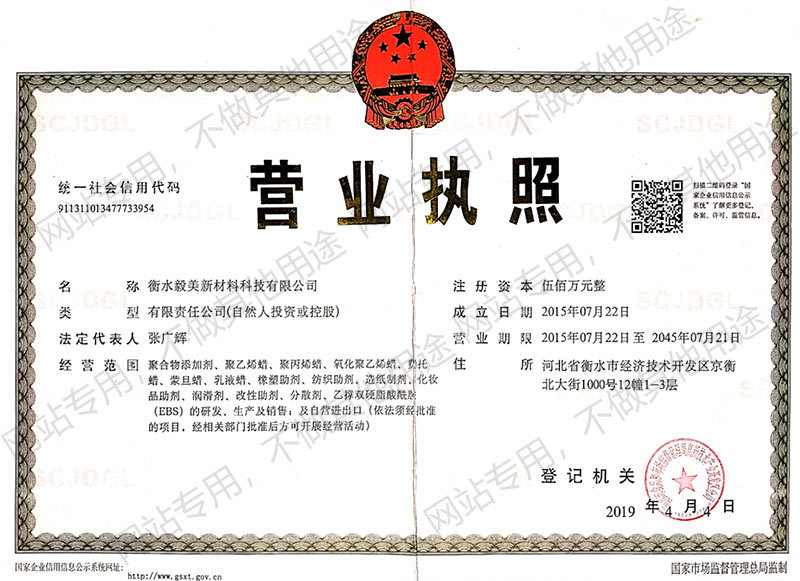
About UsHengshui yi mei new material technology co., ltd. was founded in 2015, is a collection of product development, production, sales and service as one of the high and new technology enterprises, yi mei company focused on deep processing of wax products, determined to become china's professional wax products supplier

-
ProductsThe company mainly produces and sells: polyethylene wax, oxidized polyethylene wax, synthetic Fischer-Tropsch wax, oxidized Fischer-Tropsch wax, maleic anhydride grafted wax, polypropylene wax, micro-powder wax, high-end composite wax and other eight series of dozens of models of high quality products.
-
NewsAt the beginning of its establishment, Yimei Company invested in the establishment of the "Polymer Additive R & D Center", insisting on scientific and technological innovation as the life force of enterprise development. Concentrate funds, technology, and talents in the company's scientific and technological innovation activities, focus on scientific research, public relations and technological breakthroughs of new products, new technologies, and new processes, and resolutely master core technologies.
-
SupportAt the beginning of its establishment, Yimei Company invested in the establishment of the "Polymer Additive R & D Center", insisting on scientific and technological innovation as the life force of enterprise development. Concentrate funds, technology, and talents in the company's scientific and technological innovation activities, focus on scientific research, public relations and technological breakthroughs of new products, new technologies, and new processes, and resolutely master core technologies.
-
RecruitmentOur company always adheres to the talent concept of "people-oriented", actively creates an atmosphere of respect, understanding, integrity and friendship, respects people's knowledge and talents, selects and develops mechanisms, and provides a growth platform for talents. make talents become a strong support for the sustainable development of enterprises, and realize the common growth and development of enterprises and talents.


Lead Salt Stabilizers: A Key Component for Enhancing Industrial Processes
Release time:
2024-11-14
Lead Salt Stabilizers: A Key Component for Enhancing Industrial Processes Table of Contents Introduction to Lead Salt Stabilizers What Are Lead Salt Stabilizers? Applications of Lead Salt Stabilizers in Industry Benefits of Using Lead Salt Stabilizers Mechanism of Action of Lead Salt Stabilizers Health and Safety Considerations The Future of Lead Salt Stabilizers in In
Lead Salt Stabilizers: A Key Component for Enhancing Industrial Processes
Table of Contents
- Introduction to Lead Salt Stabilizers
- What Are Lead Salt Stabilizers?
- Applications of Lead Salt Stabilizers in Industry
- Benefits of Using Lead Salt Stabilizers
- Mechanism of Action of Lead Salt Stabilizers
- Health and Safety Considerations
- The Future of Lead Salt Stabilizers in Industrial Processes
- Frequently Asked Questions
- Conclusion
Introduction to Lead Salt Stabilizers
Lead Salt Stabilizers are critical additives in various industrial applications, particularly in the polymer industry. They significantly enhance the performance characteristics of products, providing stability and durability that are essential for optimal functioning. These stabilizers play a pivotal role in ensuring that materials retain their integrity and functionality over time, making them indispensable in several manufacturing processes.
What Are Lead Salt Stabilizers?
Lead Salt Stabilizers are chemical compounds that serve as stabilizing agents in the production of PVC (Polyvinyl Chloride) and other polymers. These stabilizers are typically composed of lead salts derived from fatty acids and are known for their effectiveness in preventing degradation during processing. Their unique chemical properties allow them to absorb heat and prevent the breakdown of polymer chains, which can lead to discoloration and loss of mechanical properties.
Types of Lead Salt Stabilizers
There are various types of Lead Salt Stabilizers, including:
1. **Lead Stearate**: A widely used stabilizer that provides excellent thermal stability.
2. **Lead Octoate**: Known for its high efficiency and compatibility with other additives.
3. **Lead Phthalate**: Often used in flexible formulations due to its superior properties.
Each type serves specific functions within industrial applications, and the choice of stabilizer often depends on the desired characteristics of the final product.
Applications of Lead Salt Stabilizers in Industry
Lead Salt Stabilizers find extensive use in various sectors, including:
1. PVC Production
In the production of PVC, Lead Salt Stabilizers enhance the thermal stability and processing characteristics. They help in maintaining the color and mechanical properties of the material during and after processing.
2. Coatings and Paints
Lead Salt Stabilizers are also used in coatings and paints to improve the durability and sheen of products. They prevent the degradation of the paint film and enhance the adhesion properties.
3. Plastics
These stabilizers are integral in manufacturing various plastic products, ensuring they withstand environmental factors such as heat and UV radiation.
4. Rubber and Elastomers
Lead Salt Stabilizers are utilized in rubber production to improve processing and end-use performance, ensuring longevity and resistance to wear.
5. Adhesives and Sealants
In adhesives and sealants, these stabilizers enhance performance, providing better bonding strength and resistance to environmental factors.
Benefits of Using Lead Salt Stabilizers
The incorporation of Lead Salt Stabilizers into industrial processes offers numerous advantages:
1. Enhanced Thermal Stability
Lead Salt Stabilizers increase the thermal stability of materials, thereby prolonging their lifespan and utility.
2. Improved Mechanical Properties
By preventing degradation during processing, these stabilizers help maintain the mechanical integrity of the final product.
3. Cost-Effectiveness
Utilizing Lead Salt Stabilizers can lead to cost savings in production by reducing waste and enhancing material performance.
4. Versatility
They can be used in a wide range of applications, making them a flexible choice for manufacturers across various industries.
5. Increased Product Quality
Lead Salt Stabilizers contribute to the overall quality of the end products, ensuring they meet industry standards and consumer expectations.
Mechanism of Action of Lead Salt Stabilizers
Understanding the mechanism of action of Lead Salt Stabilizers is crucial for optimizing their use in industrial processes. These stabilizers work by:
1. **Heat Absorption**: They absorb and dissipate heat generated during processing, preventing thermal degradation of the materials.
2. **Chain Termination**: Lead Salt Stabilizers interrupt the chain reaction of free radicals that lead to polymer degradation.
3. **Complex Formation**: They form stable complexes with potential degradation products, which helps in maintaining the quality of the polymer.
These mechanisms work together to ensure that the materials retain their desirable properties throughout their lifecycle.
Health and Safety Considerations
While Lead Salt Stabilizers offer significant benefits, it is essential to consider the associated health and environmental risks. Lead compounds can be toxic, and their use is subject to stringent regulations in many jurisdictions.
1. Regulatory Compliance
Manufacturers must comply with local and international regulations regarding the use of lead-containing substances. This includes proper handling, storage, and disposal practices.
2. Worker Safety
Implementing safety protocols and training for workers handling Lead Salt Stabilizers is crucial in mitigating health risks.
3. Environmental Impact
Efforts should be made to minimize environmental contamination during production and disposal, ensuring sustainable practices are followed.
The Future of Lead Salt Stabilizers in Industrial Processes
As industries evolve, the future of Lead Salt Stabilizers will depend on innovations in formulations and regulatory changes. The industry is witnessing a shift towards safer alternatives, driven by environmental concerns and health regulations.
1. Emerging Alternatives
Research is ongoing to develop non-toxic alternatives that can replace lead-based stabilizers without compromising performance.
2. Technological Advances
Advancements in technology may lead to the development of more efficient stabilizers that provide similar benefits with lower environmental impact.
3. Sustainable Practices
The push for sustainability will encourage manufacturers to adopt greener practices and explore eco-friendly additives in place of traditional Lead Salt Stabilizers.
Frequently Asked Questions
1. What are the primary uses of Lead Salt Stabilizers?
Lead Salt Stabilizers are primarily used in PVC production, coatings, plastics, rubber, and adhesives to enhance thermal stability and product quality.
2. Are Lead Salt Stabilizers safe to use?
While they provide significant benefits, Lead Salt Stabilizers can be toxic. Compliance with safety regulations and proper handling is essential to minimize health risks.
3. How do Lead Salt Stabilizers work?
They function by absorbing heat, terminating free radical chains, and forming stable complexes, preventing material degradation during processing.
4. What are the alternatives to Lead Salt Stabilizers?
Ongoing research is focused on developing non-toxic alternatives that maintain performance while reducing environmental impact.
5. What is the future outlook for Lead Salt Stabilizers?
The future will likely see advancements in safer alternatives, technological innovations, and a focus on sustainable practices in the chemical industry.
Conclusion
Lead Salt Stabilizers are invaluable components in enhancing industrial processes, offering benefits that significantly improve product quality and durability. However, as the industry moves towards greener and safer alternatives, it is essential to balance performance with health and environmental considerations. By staying informed and adapting to these changes, manufacturers can continue to leverage the advantages of Lead Salt Stabilizers while contributing to a more sustainable future.
Key words:
lead salt stabilizer
recommend reading