Yimei New Material-Professional Wax Product Solution Supplier


-
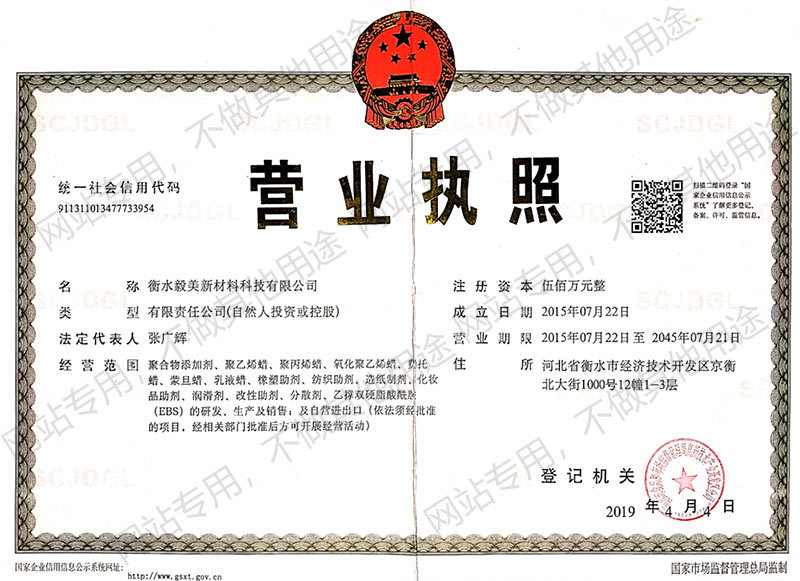
About UsHengshui yi mei new material technology co., ltd. was founded in 2015, is a collection of product development, production, sales and service as one of the high and new technology enterprises, yi mei company focused on deep processing of wax products, determined to become china's professional wax products supplier

-
ProductsThe company mainly produces and sells: polyethylene wax, oxidized polyethylene wax, synthetic Fischer-Tropsch wax, oxidized Fischer-Tropsch wax, maleic anhydride grafted wax, polypropylene wax, micro-powder wax, high-end composite wax and other eight series of dozens of models of high quality products.
-
NewsAt the beginning of its establishment, Yimei Company invested in the establishment of the "Polymer Additive R & D Center", insisting on scientific and technological innovation as the life force of enterprise development. Concentrate funds, technology, and talents in the company's scientific and technological innovation activities, focus on scientific research, public relations and technological breakthroughs of new products, new technologies, and new processes, and resolutely master core technologies.
-
SupportAt the beginning of its establishment, Yimei Company invested in the establishment of the "Polymer Additive R & D Center", insisting on scientific and technological innovation as the life force of enterprise development. Concentrate funds, technology, and talents in the company's scientific and technological innovation activities, focus on scientific research, public relations and technological breakthroughs of new products, new technologies, and new processes, and resolutely master core technologies.
-
RecruitmentOur company always adheres to the talent concept of "people-oriented", actively creates an atmosphere of respect, understanding, integrity and friendship, respects people's knowledge and talents, selects and develops mechanisms, and provides a growth platform for talents. make talents become a strong support for the sustainable development of enterprises, and realize the common growth and development of enterprises and talents.


Understanding the Mechanisms: How Lead Salt Stabilizers Work in Formulations
Release time:
2024-11-12
Understanding the Mechanisms: How Lead Salt Stabilizers Work in Formulations Table of Contents 1. Introduction to Lead Salt Stabilizers 2. Types of Lead Salt Stabilizers 3. Mechanisms of Action 4. Applications in Various Industries 5. Advantages of Using Lead Salt Stabilizers 6. Safety and Environmental Considerations 7. Regulatory Landscape 8. The Future of Lead S
Understanding the Mechanisms: How Lead Salt Stabilizers Work in Formulations
Table of Contents
- 1. Introduction to Lead Salt Stabilizers
- 2. Types of Lead Salt Stabilizers
- 3. Mechanisms of Action
- 4. Applications in Various Industries
- 5. Advantages of Using Lead Salt Stabilizers
- 6. Safety and Environmental Considerations
- 7. Regulatory Landscape
- 8. The Future of Lead Salt Stabilizers
- 9. Frequently Asked Questions
- 10. Conclusion
1. Introduction to Lead Salt Stabilizers
Lead salt stabilizers are essential components in various chemical formulations, particularly in the plastics industry. These stabilizers enhance the thermal stability and longevity of products, preventing degradation over time. Lead salts play a crucial role in stabilizing polymers against the damaging effects of heat, light, and oxygen, thus ensuring high performance and durability.
In this article, we will explore the types of lead salt stabilizers, their mechanisms of action, applications across different industries, advantages, safety considerations, and the current regulatory landscape. Understanding these aspects is vital for chemical professionals seeking to optimize formulations.
2. Types of Lead Salt Stabilizers
There are several types of lead salt stabilizers, each with unique properties and applications. The most common types include:
2.1 Basic Lead Stearate
Basic lead stearate is widely used in PVC formulations. It acts as a heat stabilizer and provides excellent lubrication during processing. This stabilizer enhances the thermal stability of products while offering a smooth texture.
2.2 Lead Octoate
Lead octoate is another prevalent stabilizer, known for its efficacy in enhancing the resistance of materials to thermal degradation. It is often used in coatings and sealants, providing improved durability and weather resistance.
2.3 Lead Sulfate
Lead sulfate is used in specialized applications, particularly in industrial settings. It serves as a stabilizer in lubricants and greases, providing enhanced performance under extreme conditions.
2.4 Other Lead Salts
Besides the aforementioned types, other lead salts, such as lead carbonate and lead acetate, find applications as stabilizers in various formulations, depending on the required properties.
3. Mechanisms of Action
Understanding how lead salt stabilizers work is key to utilizing them effectively in formulations. Their mechanisms can be broken down into several key processes:
3.1 Thermal Stabilization
Lead salt stabilizers inhibit the degradation of polymers by absorbing heat and releasing it slowly. This process reduces the risk of thermal degradation, ensuring that materials maintain their integrity under elevated temperatures during processing.
3.2 Antioxidant Properties
Lead salts also exhibit antioxidant properties, preventing chain reactions that lead to polymer degradation. They scavenge free radicals generated during thermal stress, thus preserving the physical and chemical properties of the material.
3.3 UV Protection
In addition to thermal stability, lead salt stabilizers provide protection against UV radiation. They absorb UV light and convert it into harmless thermal energy, preventing photo-oxidative degradation of polymers.
4. Applications in Various Industries
Lead salt stabilizers find applications in multiple industries, including:
4.1 Plastics and Polymers
In the plastics industry, lead salt stabilizers are primarily used in PVC formulations. They enhance processability and extend the lifespan of products, making them ideal for construction materials, cables, and pipes.
4.2 Coatings and Sealants
In coatings and sealants, lead salts improve durability and resistance to environmental factors. They are essential in formulating high-performance paints and protective coatings for various substrates.
4.3 Rubber Manufacturing
Lead salt stabilizers are also utilized in rubber manufacturing, where they enhance the heat stability of rubber products, ensuring better performance in high-temperature applications.
5. Advantages of Using Lead Salt Stabilizers
The use of lead salt stabilizers in formulations offers several advantages:
5.1 Enhanced Durability
Products formulated with lead salt stabilizers exhibit improved durability, making them suitable for demanding applications where longevity is crucial.
5.2 Cost-Effectiveness
By prolonging the lifespan of products, lead salt stabilizers contribute to reduced costs associated with replacements and maintenance, providing a cost-effective solution for manufacturers.
5.3 Improved Performance
Lead salt stabilizers enhance the overall performance of formulations, ensuring that products maintain their desired properties over time.
6. Safety and Environmental Considerations
While lead salt stabilizers are effective, safety and environmental concerns must be addressed. Lead compounds can pose health risks if not handled properly. It is essential for manufacturers to implement safety protocols during production and usage.
6.1 Handling Precautions
Proper handling procedures, including the use of personal protective equipment (PPE), are vital to minimize exposure to lead salts.
6.2 Environmental Impact
The environmental impact of lead salts must be considered, leading to increased scrutiny and the need for sustainable alternatives in some applications.
7. Regulatory Landscape
The use of lead salt stabilizers is subject to regulation in many countries due to health and environmental concerns. Understanding the regulatory landscape is crucial for manufacturers to ensure compliance.
7.1 International Guidelines
International organizations, such as the World Health Organization (WHO) and the European Chemicals Agency (ECHA), provide guidelines on the use and safety of lead compounds.
7.2 Regional Regulations
Many countries have specific regulations governing the use of lead in industrial applications, necessitating manufacturers to stay informed about local laws.
8. The Future of Lead Salt Stabilizers
The future of lead salt stabilizers is evolving, with increasing focus on sustainability and environmental responsibility. Researchers are exploring alternative stabilizers that can provide similar benefits without the associated risks of lead compounds.
8.1 Innovations in Stabilization Technology
Advancements in formulation technology may lead to the development of new stabilizers that offer comparable performance with lower environmental impact.
8.2 Industry Adaptations
Industries are adapting to regulatory changes and consumer demand for safer products, indicating a shift towards more sustainable practices in the use of stabilizers.
9. Frequently Asked Questions
9.1 What are lead salt stabilizers used for?
Lead salt stabilizers are primarily used in plastics, coatings, and rubber manufacturing to enhance thermal stability and durability.
9.2 Are lead salt stabilizers safe to use?
While lead salt stabilizers are effective, they pose health risks if not handled properly. Safety precautions should be taken during handling and processing.
9.3 What are the alternatives to lead salt stabilizers?
Alternatives include calcium-based stabilizers and other non-toxic compounds that provide similar stabilization effects without the risks associated with lead.
9.4 How do lead salt stabilizers compare to other stabilizers?
Lead salt stabilizers often provide superior performance in terms of thermal stability and longevity compared to some alternative stabilizers.
9.5 What is the regulatory status of lead salt stabilizers?
The use of lead salt stabilizers is regulated in many countries due to health and environmental concerns, requiring compliance with local laws.
10. Conclusion
In conclusion, lead salt stabilizers are pivotal in enhancing the performance and durability of various chemical formulations. Their mechanisms of action, diverse applications, and advantages make them invaluable in industries such as plastics, coatings, and rubber manufacturing. However, safety and regulatory considerations must be at the forefront of their use. As the industry moves towards more sustainable practices, the future may see innovations that provide effective stabilization without the risks associated with lead. Understanding these dynamics will empower professionals to make informed decisions in formulation practices.
Key words:
lead salt stabilizer
recommend reading