Yimei New Material-Professional Wax Product Solution Supplier


-
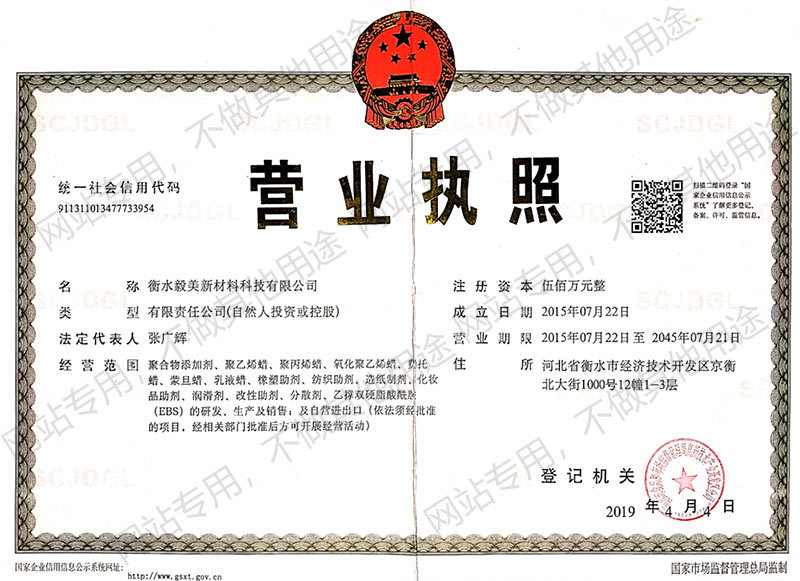
About UsHengshui yi mei new material technology co., ltd. was founded in 2015, is a collection of product development, production, sales and service as one of the high and new technology enterprises, yi mei company focused on deep processing of wax products, determined to become china's professional wax products supplier

-
ProductsThe company mainly produces and sells: polyethylene wax, oxidized polyethylene wax, synthetic Fischer-Tropsch wax, oxidized Fischer-Tropsch wax, maleic anhydride grafted wax, polypropylene wax, micro-powder wax, high-end composite wax and other eight series of dozens of models of high quality products.
-
NewsAt the beginning of its establishment, Yimei Company invested in the establishment of the "Polymer Additive R & D Center", insisting on scientific and technological innovation as the life force of enterprise development. Concentrate funds, technology, and talents in the company's scientific and technological innovation activities, focus on scientific research, public relations and technological breakthroughs of new products, new technologies, and new processes, and resolutely master core technologies.
-
SupportAt the beginning of its establishment, Yimei Company invested in the establishment of the "Polymer Additive R & D Center", insisting on scientific and technological innovation as the life force of enterprise development. Concentrate funds, technology, and talents in the company's scientific and technological innovation activities, focus on scientific research, public relations and technological breakthroughs of new products, new technologies, and new processes, and resolutely master core technologies.
-
RecruitmentOur company always adheres to the talent concept of "people-oriented", actively creates an atmosphere of respect, understanding, integrity and friendship, respects people's knowledge and talents, selects and develops mechanisms, and provides a growth platform for talents. make talents become a strong support for the sustainable development of enterprises, and realize the common growth and development of enterprises and talents.


Understanding the Manufacturing Process of PVC Resin SG5: A Comprehensive Guide
Release time:
2024-10-31
Understanding the Manufacturing Process of PVC Resin SG5 Table of Contents 1. Introduction to PVC Resin SG5 2. What is PVC Resin SG5? 3. Raw Materials Used in PVC Resin SG5 Production 4. The Manufacturing Process of PVC Resin SG5 4.1 Polymerization Process 4.2 Incorporation of Additives 4.3 Pelletization Techniques 5. Quali
Understanding the Manufacturing Process of PVC Resin SG5
Table of Contents
- 1. Introduction to PVC Resin SG5
- 2. What is PVC Resin SG5?
- 3. Raw Materials Used in PVC Resin SG5 Production
- 4. The Manufacturing Process of PVC Resin SG5
- 5. Quality Control Measures in PVC Resin SG5 Production
- 6. Applications of PVC Resin SG5
- 7. Environmental Considerations in PVC Production
- 8. Future Trends in PVC Resin SG5 Manufacturing
- 9. Frequently Asked Questions
- 10. Conclusion
1. Introduction to PVC Resin SG5
The world of polymers is vast and multifaceted, with PVC (Polyvinyl Chloride) taking center stage in numerous applications due to its versatility and durability. Among the various grades of PVC, **SG5** stands out as a preferred choice in various industries. Understanding its manufacturing process not only sheds light on its properties but also highlights the significant role it plays in modern materials science.
2. What is PVC Resin SG5?
PVC Resin SG5 is a high-grade thermoplastic polymer known for its excellent mechanical properties and thermal stability. It is commonly used in both rigid and flexible formulations, making it an ideal choice for products ranging from pipes and fittings to window profiles and flooring. Its unique properties, such as resistance to chemicals and UV radiation, contribute to its widespread adoption.
3. Raw Materials Used in PVC Resin SG5 Production
The production of PVC Resin SG5 begins with several key raw materials:
3.1 Vinyl Chloride Monomer (VCM)
VCM is the primary building block for PVC. It is produced via the **ethylene dichloride (EDC)** method, where ethylene and chlorine react to create EDC, which is then thermally cracked to yield VCM.
3.2 Additives
Various additives are incorporated during production to enhance the properties of PVC Resin SG5. These include:
- **Stabilizers:** Prevent degradation during processing and extend the material's lifespan.
- **Plasticizers:** Increase flexibility and workability.
- **Fillers:** Improve mechanical properties and reduce production costs.
3.3 Other Chemicals
Additional chemicals such as lubricants, pigments, and impact modifiers may also be utilized to achieve specific characteristics in the final product.
4. The Manufacturing Process of PVC Resin SG5
The manufacturing process of PVC Resin SG5 involves several critical steps, each contributing to the quality and effectiveness of the final product.
4.1 Polymerization Process
The polymerization of VCM is the first step in creating PVC Resin SG5. This process can be carried out using various methods, including:
- **Suspension Polymerization:** This method offers high purity and excellent control over particle size. VCM is polymerized in water with the help of suspending agents.
- **Emulsion Polymerization:** Suitable for producing fine particles, this method uses surfactants to stabilize the emulsion of VCM in water.
- **Bulk Polymerization:** Involves polymerizing VCM without a solvent, yielding a high molecular weight product.
The choice of polymerization method significantly influences the resin's properties.
4.2 Incorporation of Additives
Once the base polymer is formed, additives are blended into the PVC Resin SG5 to impart desired characteristics. The mixing process must ensure uniform distribution of all components to avoid inconsistencies in quality. Each additive serves a specific purpose:
- **Stabilizers** prevent degradation due to heat during processing.
- **Plasticizers** enhance flexibility, essential for applications requiring pliability.
- **Fillers** provide bulk and reduce costs while maintaining physical properties.
4.3 Pelletization Techniques
After blending, the material is subjected to pelletization, transforming it into small granules. This process facilitates ease of handling and further processing. Techniques such as **extrusion** and **granulation** are commonly employed. The choice of technique directly affects the consistency and processing behavior of the final product.
5. Quality Control Measures in PVC Resin SG5 Production
Quality control is an integral aspect of PVC Resin SG5 manufacturing. Rigorous testing and adherence to industry standards ensure that every batch meets the required specifications. Key quality control measures include:
5.1 Raw Material Inspection
All incoming raw materials undergo thorough inspection and testing to verify their quality and compatibility with the production process.
5.2 In-Process Monitoring
Continuous monitoring during the manufacturing process helps identify any deviations from established parameters, allowing for timely adjustments.
5.3 Final Product Testing
Before packaging, the final product is tested for various properties, including:
- **Melt Flow Index (MFI):** Indicates processability.
- **Tensile Strength:** Measures mechanical strength.
- **Impact Resistance:** Assesses durability.
Adhering to these quality control measures ensures that the PVC Resin SG5 produced is reliable and meets performance expectations.
6. Applications of PVC Resin SG5
PVC Resin SG5 finds extensive use across various industries due to its adaptable nature and beneficial properties. Key applications include:
6.1 Construction
In the construction industry, PVC Resin SG5 is commonly used for pipes, fittings, and profiles. Its resistance to corrosion and chemicals makes it an ideal choice for plumbing and drainage systems.
6.2 Automotive Industry
PVC is utilized in the automotive sector for interior trims, dashboards, and under-the-hood components due to its durability and ability to withstand harsh conditions.
6.3 Consumer Goods
Products such as medical devices, toys, and household items often incorporate PVC Resin SG5, benefiting from its versatility and safety characteristics.
7. Environmental Considerations in PVC Production
While PVC Resin SG5 offers numerous advantages, its production and disposal raise environmental concerns.
7.1 Sustainable Practices
Manufacturers are increasingly adopting sustainable practices, including:
- **Recycling:** Efforts to recycle PVC materials can significantly reduce waste.
- **Eco-friendly Additives:** Utilizing environmentally friendly additives can minimize harmful impacts.
7.2 Regulatory Compliance
Companies must adhere to stringent environmental regulations regarding emissions and waste management to minimize their ecological footprint.
8. Future Trends in PVC Resin SG5 Manufacturing
As industries evolve, so too does the manufacturing landscape of PVC Resin SG5. Key trends shaping the future include:
8.1 Innovation in Polymerization Technologies
Advancements in polymerization technologies are likely to enhance efficiency and reduce costs, making PVC production more sustainable.
8.2 Focus on Bio-based Alternatives
The development of bio-based PVC resins is gaining momentum as manufacturers seek greener alternatives to traditional materials.
9. Frequently Asked Questions
9.1 What is the primary use of PVC Resin SG5?
PVC Resin SG5 is primarily used in construction, automotive, and consumer goods due to its versatility and durability.
9.2 How is PVC Resin SG5 produced?
The production involves polymerizing vinyl chloride monomer (VCM), incorporating additives, and pelletization.
9.3 What are the environmental impacts of PVC production?
PVC production can generate emissions and waste. Manufacturers are implementing sustainable practices to mitigate these impacts.
9.4 Can PVC Resin SG5 be recycled?
Yes, PVC Resin SG5 is recyclable, and initiatives are in place to promote recycling within the industry.
9.5 What are some common applications of PVC Resin SG5?
Common applications include pipes, automotive parts, and consumer goods like toys and medical devices.
10. Conclusion
The manufacturing process of PVC Resin SG5 is a complex yet fascinating journey that highlights the incredible capabilities of this versatile polymer. From the careful selection of raw materials to the rigorous quality control measures in place, each step is crucial in delivering a product that meets the demands of numerous industries. As we look to the future, the focus on sustainable practices and innovations will undoubtedly shape the landscape of PVC production, ensuring its role remains vital in our evolving world. Understanding this process gives us a greater appreciation for the materials that underpin modern life and their impact on our environment and economy.
Key words:
PVC Resin SG5
Previous article
recommend reading