Yimei New Material-Professional Wax Product Solution Supplier


-
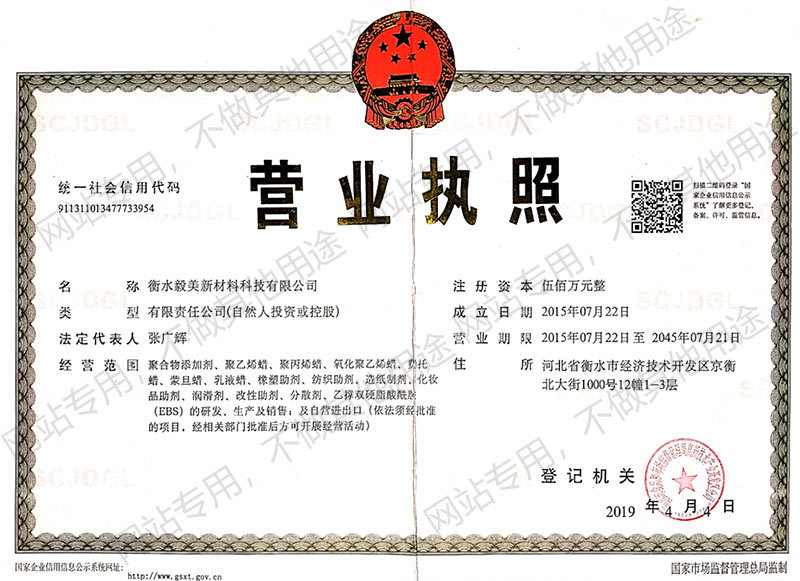
About UsHengshui yi mei new material technology co., ltd. was founded in 2015, is a collection of product development, production, sales and service as one of the high and new technology enterprises, yi mei company focused on deep processing of wax products, determined to become china's professional wax products supplier

-
ProductsThe company mainly produces and sells: polyethylene wax, oxidized polyethylene wax, synthetic Fischer-Tropsch wax, oxidized Fischer-Tropsch wax, maleic anhydride grafted wax, polypropylene wax, micro-powder wax, high-end composite wax and other eight series of dozens of models of high quality products.
-
NewsAt the beginning of its establishment, Yimei Company invested in the establishment of the "Polymer Additive R & D Center", insisting on scientific and technological innovation as the life force of enterprise development. Concentrate funds, technology, and talents in the company's scientific and technological innovation activities, focus on scientific research, public relations and technological breakthroughs of new products, new technologies, and new processes, and resolutely master core technologies.
-
SupportAt the beginning of its establishment, Yimei Company invested in the establishment of the "Polymer Additive R & D Center", insisting on scientific and technological innovation as the life force of enterprise development. Concentrate funds, technology, and talents in the company's scientific and technological innovation activities, focus on scientific research, public relations and technological breakthroughs of new products, new technologies, and new processes, and resolutely master core technologies.
-
RecruitmentOur company always adheres to the talent concept of "people-oriented", actively creates an atmosphere of respect, understanding, integrity and friendship, respects people's knowledge and talents, selects and develops mechanisms, and provides a growth platform for talents. make talents become a strong support for the sustainable development of enterprises, and realize the common growth and development of enterprises and talents.


How PP Wax Enhances the Performance of Coatings: Unleashing the Power of Polypropylene Wax
Release time:
2024-10-03
How PP Wax Enhances the Performance of Coatings In the realm of coatings, achieving optimal performance is paramount. One of the most effective materials making waves in the industry is polypropylene wax (PP wax). This unique additive is transforming how coatings are formulated and applied, offering enhanced properties that contribute to improved durability, aesthetics, and overall performance. In
How PP Wax Enhances the Performance of Coatings
In the realm of coatings, achieving optimal performance is paramount. One of the most effective materials making waves in the industry is polypropylene wax (PP wax). This unique additive is transforming how coatings are formulated and applied, offering enhanced properties that contribute to improved durability, aesthetics, and overall performance. In this comprehensive article, we will delve into the multifaceted benefits of PP wax in coatings and how it can elevate product quality to new heights.
Understanding PP Wax: What is Polypropylene Wax?
Polypropylene wax is a low-molecular-weight polymer derived from the polymerization of propylene monomers. It is recognized for its exceptional thermal stability, chemical resistance, and low viscosity. These properties make PP wax an invaluable addition in the formulation of various coatings, adhesives, and sealants. By incorporating PP wax, manufacturers can significantly enhance the performance characteristics of their products.
The Composition and Properties of PP Wax
PP wax is composed primarily of long-chain hydrocarbons, which impart unique properties to the material. Some notable characteristics include:
- Excellent Thermal Stability: PP wax maintains its physical properties across a wide temperature range, making it suitable for high-temperature applications.
- Water Resistance: Its hydrophobic nature ensures that coatings remain intact even in humid or wet conditions.
- Low Viscosity: This allows for easy incorporation into various formulations without significantly altering the viscosity of the coating.
- Chemical Resistance: PP wax is resistant to many solvents, acids, and bases, ensuring longevity and durability of the coatings.
The Role of PP Wax in Coating Formulations
Incorporating PP wax into coating formulations can dramatically enhance several critical performance aspects. Let’s explore how it contributes to improved coatings.
1. Enhanced Scratch Resistance
One of the significant advantages of using PP wax is its ability to improve scratch resistance. By forming a protective layer on the coating surface, PP wax helps to prevent physical damage caused by abrasions or impacts. This is particularly important in applications such as automotive paints, industrial coatings, and protective films.
2. Improved Gloss and Surface Finish
PP wax can significantly enhance the gloss and smoothness of coatings. Its incorporation leads to a more aesthetically pleasing finish, which is especially crucial in decorative applications. Additionally, the glossy surface produced by PP wax increases the visual appeal of the final product, making it more marketable.
3. Reduced Surface Tension
Another remarkable benefit of PP wax is its ability to reduce surface tension within the coating. This results in improved wetting and leveling during the application process, allowing for a smoother, more uniform finish. Products that utilize PP wax often exhibit superior flow characteristics, leading to a better overall application experience.
4. Enhanced Durability and Longevity
Coatings that incorporate PP wax typically have greater durability and resistance to environmental factors. The enhanced stability provided by PP wax helps coatings withstand exposure to UV light, moisture, and temperature variations without degrading. This longevity is particularly advantageous in exterior applications where coatings are subjected to harsh conditions.
Applications of PP Wax in Various Coatings
PP wax has established a strong presence in various industries due to its remarkable properties. Here are some applications where its benefits shine:
1. Automotive Coatings
In the automotive industry, durability and aesthetics are paramount. The incorporation of PP wax in automotive paints results in coatings that are more resistant to scratches, chips, and environmental damage. This contributes to longer-lasting finishes and reduced maintenance costs for vehicle owners.
2. Architectural Coatings
When it comes to architectural coatings, PP wax enhances both performance and appearance. It provides superior adhesion, improved water resistance, and a high-gloss finish. These attributes are crucial for exterior paints and finishes that face the elements.
3. Industrial Coatings
Industrial coatings require robust performance capabilities. The addition of PP wax helps increase resistance to chemicals, making it an ideal choice for coatings used in manufacturing and processing environments. This ensures that the coatings can withstand the rigors of industrial applications.
4. Wood Coatings
Wood coatings benefit greatly from the inclusion of PP wax, as it enhances the protective properties of the coating while providing a beautiful finish. The wax aids in repelling water and resisting scratches, making it an excellent choice for furniture and flooring applications.
Formulating with PP Wax: Best Practices
To maximize the benefits of PP wax in any coating formulation, certain best practices should be followed:
1. Proper Dispersion Techniques
When incorporating PP wax into a formulation, it is crucial to ensure proper dispersion. Utilizing high shear mixing techniques can help achieve a homogeneous distribution, which is essential for optimal performance.
2. Optimal Concentration Levels
Finding the right concentration of PP wax is key. Too little may not provide adequate benefits, while too much can adversely affect the coating’s properties. Conducting trials to determine the ideal concentration for specific applications is recommended.
3. Compatibility with Other Additives
PP wax should be tested for compatibility with other additives in the formulation. Understanding how it interacts with other components will ensure that the final product meets performance expectations.
Market Trends and Future Prospects of PP Wax in Coatings
As industries continue to evolve, the demand for high-performance coatings is on the rise. The use of PP wax is expected to grow due to its versatility and ability to enhance key properties of coatings. Future trends may include:
1. Eco-Friendly Formulations
With increasing environmental concerns, there is a push towards developing eco-friendly coatings. PP wax can be formulated from renewable sources, making it an attractive option for sustainable coating solutions.
2. Innovation in Coating Technologies
Advancements in coating technologies will likely drive further innovation in the use of PP wax. As manufacturers seek to improve performance and minimize production costs, the role of PP wax will become even more critical.
3. Customized Coating Solutions
As industries become more specialized, the demand for customized coating solutions will increase. PP wax offers a flexible platform for formulators to tailor products to meet specific performance requirements.
Frequently Asked Questions (FAQs)
1. What is PP wax primarily used for in coatings?
PP wax is used to enhance scratch resistance, improve gloss, reduce surface tension, and increase durability in various coatings.
2. Is PP wax environmentally friendly?
PP wax can be formulated from renewable sources, making it a more sustainable choice compared to traditional waxes.
3. How does PP wax improve the application process of coatings?
By reducing surface tension, PP wax allows for better wetting and leveling during application, resulting in a smoother finish.
4. Can PP wax be used in both water-based and solvent-based coatings?
Yes, PP wax is compatible with both types of coatings, making it a versatile additive for various formulations.
5. What factors should I consider when formulating with PP wax?
Consider proper dispersion techniques, optimal concentration levels, and compatibility with other additives to maximize performance.
Conclusion
The incorporation of polypropylene wax in coatings represents a significant advancement in the quest for superior performance and durability. From enhanced scratch resistance to improved aesthetic qualities, PP wax provides a multitude of benefits that can transform a basic coating into a high-performance solution. As the industry continues to evolve, the use of PP wax will undoubtedly play a critical role in meeting the ever-growing demands for innovative and effective coatings. By understanding its properties, applications, and best practices, manufacturers can leverage the potential of PP wax to create products that stand out in a competitive market.
Key words:
PP wax
recommend reading