Yimei New Material-Professional Wax Product Solution Supplier


-
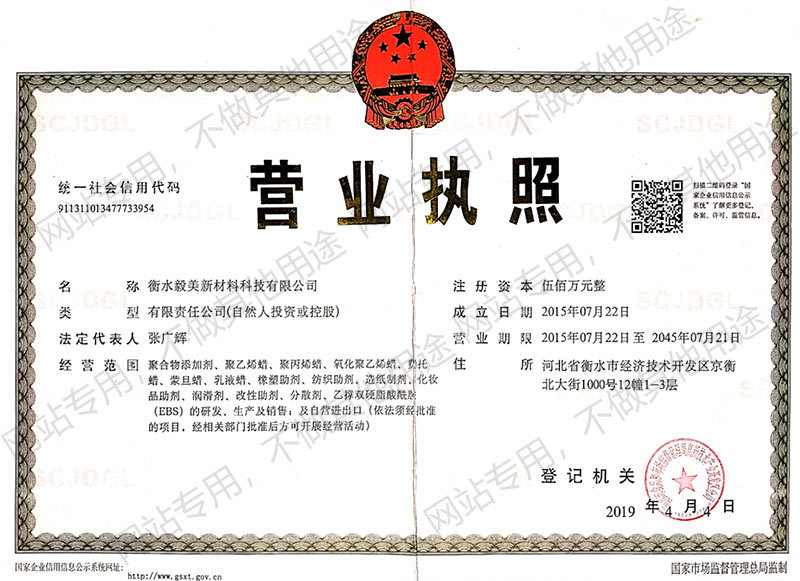
About UsHengshui yi mei new material technology co., ltd. was founded in 2015, is a collection of product development, production, sales and service as one of the high and new technology enterprises, yi mei company focused on deep processing of wax products, determined to become china's professional wax products supplier

-
ProductsThe company mainly produces and sells: polyethylene wax, oxidized polyethylene wax, synthetic Fischer-Tropsch wax, oxidized Fischer-Tropsch wax, maleic anhydride grafted wax, polypropylene wax, micro-powder wax, high-end composite wax and other eight series of dozens of models of high quality products.
-
NewsAt the beginning of its establishment, Yimei Company invested in the establishment of the "Polymer Additive R & D Center", insisting on scientific and technological innovation as the life force of enterprise development. Concentrate funds, technology, and talents in the company's scientific and technological innovation activities, focus on scientific research, public relations and technological breakthroughs of new products, new technologies, and new processes, and resolutely master core technologies.
-
SupportAt the beginning of its establishment, Yimei Company invested in the establishment of the "Polymer Additive R & D Center", insisting on scientific and technological innovation as the life force of enterprise development. Concentrate funds, technology, and talents in the company's scientific and technological innovation activities, focus on scientific research, public relations and technological breakthroughs of new products, new technologies, and new processes, and resolutely master core technologies.
-
RecruitmentOur company always adheres to the talent concept of "people-oriented", actively creates an atmosphere of respect, understanding, integrity and friendship, respects people's knowledge and talents, selects and develops mechanisms, and provides a growth platform for talents. make talents become a strong support for the sustainable development of enterprises, and realize the common growth and development of enterprises and talents.


Exploring the Versatility of FT Wax in Other Chemical Products
Release time:
2024-10-01
Exploring the Versatility of FT Wax in Other Chemical Products Table of Contents 1. Introduction to FT Wax and Its Importance in the Chemical Industry 2. Understanding FT Wax: Composition and Properties 3. Applications of FT Wax in Other Chemical Products 3.1 FT Wax in Coatings and Finishes 3.2 FT Wax in Plastics and Polymers 3.3 FT Wax in Adhesives and Sealants
Exploring the Versatility of FT Wax in Other Chemical Products
Table of Contents
- 1. Introduction to FT Wax and Its Importance in the Chemical Industry
- 2. Understanding FT Wax: Composition and Properties
- 3. Applications of FT Wax in Other Chemical Products
- 3.1 FT Wax in Coatings and Finishes
- 3.2 FT Wax in Plastics and Polymers
- 3.3 FT Wax in Adhesives and Sealants
- 3.4 FT Wax in Textiles and Leather
- 4. Benefits of Using FT Wax in Chemical Products
- 5. The Sustainability Aspect of FT Wax
- 6. Innovative Formulations Using FT Wax
- 7. Case Studies: Successful Applications of FT Wax
- 8. Future Trends in FT Wax Applications
- 9. Frequently Asked Questions (FAQs)
- 10. Conclusion
1. Introduction to FT Wax and Its Importance in the Chemical Industry
FT Wax, derived from Fischer-Tropsch synthesis, has emerged as a crucial material in various chemical products. Its unique properties, including thermal stability, low viscosity, and excellent lubricating characteristics, make it a preferred choice in many industrial applications. As we examine the versatility of FT Wax, we will discover how it enhances the performance of other chemical products, proving essential in product formulation and innovation.
2. Understanding FT Wax: Composition and Properties
FT Wax typically consists of a mixture of long-chain hydrocarbons, predominantly waxy substances with chain lengths ranging from C20 to C50. This structure contributes to its high melting point and low molecular weight, resulting in remarkable chemical stability and resistance to degradation. Additionally, its non-toxic nature and compatibility with various solvents broaden its applicability across industries.
2.1 Chemical Composition
The primary components of FT Wax include:
- **Alkanes**: Straight-chain saturated hydrocarbons that provide excellent lubrication.
- **Alkenes**: Unsaturated hydrocarbons that enhance compatibility with various additives.
- **Cycloalkanes**: Contributing to the wax's overall stability and thermal properties.
2.2 Physical Properties
FT Wax exhibits several key physical properties:
- **Melting Point**: Ranges from 60°C to 80°C, depending on the specific formulation.
- **Viscosity**: Low viscosity at elevated temperatures facilitates easy incorporation into formulations.
- **Chemical Resistance**: Highly resistant to acids, bases, and solvents, ensuring longevity in applications.
3. Applications of FT Wax in Other Chemical Products
The versatility of FT Wax allows it to be utilized in various chemical products across different sectors. Its role in enhancing product performance, durability, and aesthetics makes it an invaluable component.
3.1 FT Wax in Coatings and Finishes
In the coatings industry, FT Wax is used to improve the gloss, hardness, and scratch resistance of paints and varnishes. By incorporating FT Wax, manufacturers can achieve a smoother finish, minimizing the appearance of defects and enhancing the overall aesthetic appeal.
3.2 FT Wax in Plastics and Polymers
FT Wax serves as an effective lubricant and processing aid in the production of plastics and polymers. Its inclusion helps reduce friction during processing, leading to improved flow characteristics and reduced energy consumption. Additionally, it contributes to the overall durability and performance of the final plastic products.
3.3 FT Wax in Adhesives and Sealants
The adhesive industry benefits from FT Wax's excellent wetting properties and compatibility with various substrates. By incorporating FT Wax, manufacturers can enhance the adhesion strength, flexibility, and heat resistance of their products, making them suitable for demanding applications.
3.4 FT Wax in Textiles and Leather
FT Wax is used in the textile and leather industries to provide water repellency and enhance the feel of fabrics. Its application results in improved fabric durability and resistance to wear, thus increasing the lifespan of textile products.
4. Benefits of Using FT Wax in Chemical Products
The incorporation of FT Wax into chemical products offers several significant benefits, including:
4.1 Enhanced Performance
The unique properties of FT Wax lead to improved performance characteristics in various applications, such as increased adhesion, reduced friction, and enhanced durability.
4.2 Cost Efficiency
By improving processing efficiency and reducing energy consumption, FT Wax can contribute to lower production costs, making it a cost-effective choice for manufacturers.
4.3 Versatility in Formulations
FT Wax can be easily formulated with other materials, allowing manufacturers to customize products to meet specific performance criteria and market demands.
5. The Sustainability Aspect of FT Wax
As industries move towards sustainable practices, FT Wax offers an eco-friendly alternative to traditional waxes. Its production process generates fewer greenhouse gases, and its versatility allows for a reduction in the use of harmful additives in various formulations.
6. Innovative Formulations Using FT Wax
The chemical industry continues to explore innovative formulations that leverage the properties of FT Wax. Researchers are developing new applications, such as:
- **Biodegradable Plastics**: Incorporating FT Wax into bio-based polymers to enhance performance and sustainability.
- **High-Performance Coatings**: Formulating coatings that resist environmental degradation while maintaining aesthetic appeal.
- **Functional Textiles**: Creating textiles with enhanced properties for specific applications, such as sportswear and outdoor gear.
7. Case Studies: Successful Applications of FT Wax
Several companies have successfully integrated FT Wax into their product lines, showcasing its versatility and effectiveness. For instance:
- **Coating Manufacturer A**: Reported a 30% improvement in scratch resistance in their premium paint line after incorporating FT Wax.
- **Adhesive Company B**: Achieved enhanced adhesion and flexibility in their sealant products, leading to increased customer satisfaction and reduced returns.
8. Future Trends in FT Wax Applications
As the demand for innovative solutions continues to grow, the future of FT Wax in the chemical industry looks promising. Key trends include:
- **Increased R&D Investment**: Companies are investing in research to explore new applications and improve existing formulations.
- **Growing Focus on Sustainable Solutions**: The shift towards eco-friendly products will drive the demand for sustainable materials like FT Wax.
9. Frequently Asked Questions (FAQs)
Q1: What is FT Wax, and how is it produced?
A1: FT Wax is a hydrocarbon product derived from Fischer-Tropsch synthesis, a process that converts carbon monoxide and hydrogen into liquid hydrocarbons.
Q2: What are the main applications of FT Wax?
A2: FT Wax is used in coatings, plastics, adhesives, textiles, and leather products to enhance performance and durability.
Q3: Is FT Wax environmentally friendly?
A3: Yes, FT Wax is considered a more sustainable alternative to traditional waxes as its production generates fewer greenhouse gas emissions.
Q4: Can FT Wax improve the performance of coatings?
A4: Absolutely! FT Wax enhances the gloss, hardness, and scratch resistance of coatings, leading to improved aesthetics and durability.
Q5: How does FT Wax contribute to cost savings in manufacturing?
A5: By improving processing efficiency and reducing energy consumption, FT Wax helps lower production costs for manufacturers.
10. Conclusion
FT Wax stands as a remarkable ingredient in the chemical industry, demonstrating its versatility across various applications. From enhancing coatings and plastics to improving adhesives and textiles, its unique properties make it an invaluable asset. As we move towards more sustainable practices, the role of FT Wax will likely expand, paving the way for innovative solutions that prioritize both performance and environmental responsibility. Embracing FT Wax not only ensures superior product quality but also aligns with the broader trend of sustainability in the chemical sector.
Key words:
FT wax
recommend reading