Yimei New Material-Professional Wax Product Solution Supplier


-
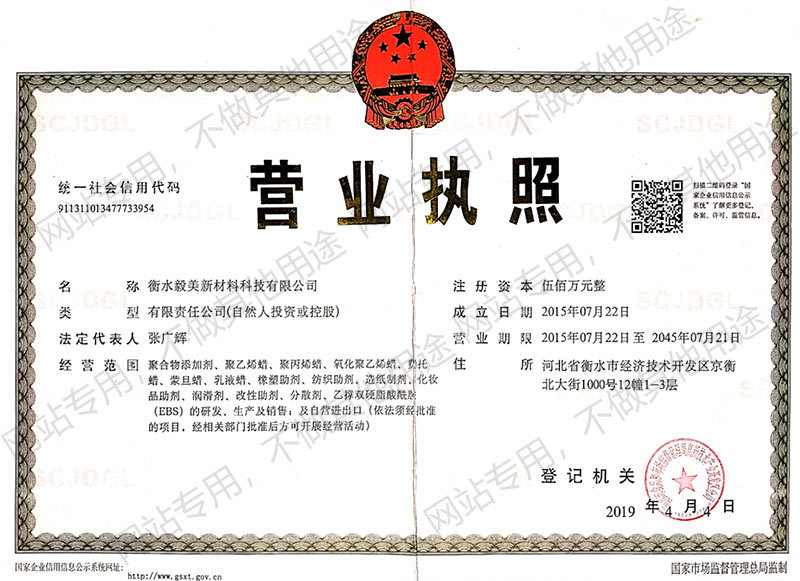
About UsHengshui yi mei new material technology co., ltd. was founded in 2015, is a collection of product development, production, sales and service as one of the high and new technology enterprises, yi mei company focused on deep processing of wax products, determined to become china's professional wax products supplier

-
ProductsThe company mainly produces and sells: polyethylene wax, oxidized polyethylene wax, synthetic Fischer-Tropsch wax, oxidized Fischer-Tropsch wax, maleic anhydride grafted wax, polypropylene wax, micro-powder wax, high-end composite wax and other eight series of dozens of models of high quality products.
-
NewsAt the beginning of its establishment, Yimei Company invested in the establishment of the "Polymer Additive R & D Center", insisting on scientific and technological innovation as the life force of enterprise development. Concentrate funds, technology, and talents in the company's scientific and technological innovation activities, focus on scientific research, public relations and technological breakthroughs of new products, new technologies, and new processes, and resolutely master core technologies.
-
SupportAt the beginning of its establishment, Yimei Company invested in the establishment of the "Polymer Additive R & D Center", insisting on scientific and technological innovation as the life force of enterprise development. Concentrate funds, technology, and talents in the company's scientific and technological innovation activities, focus on scientific research, public relations and technological breakthroughs of new products, new technologies, and new processes, and resolutely master core technologies.
-
RecruitmentOur company always adheres to the talent concept of "people-oriented", actively creates an atmosphere of respect, understanding, integrity and friendship, respects people's knowledge and talents, selects and develops mechanisms, and provides a growth platform for talents. make talents become a strong support for the sustainable development of enterprises, and realize the common growth and development of enterprises and talents.


The Role of Polyethylene Wax in Enhancing Product Performance
Release time:
2024-09-25
The Role of Polyethylene Wax in Enhancing Product Performance Table of Contents 1. Introduction to Polyethylene Wax 2. What is Polyethylene Wax? 3. Key Properties of Polyethylene Wax 4. Applications of Polyethylene Wax in Various Industries 4.1. In Coatings and Inks 4.2. In Plastics and Polymers 4.3. In Adhesives and Sealants 4.4. In Personal Care Products 5. Benefits of Using Polyethylene Wax 5.1
The Role of Polyethylene Wax in Enhancing Product Performance
Table of Contents
1. Introduction to Polyethylene Wax
2. What is Polyethylene Wax?
3. Key Properties of Polyethylene Wax
4. Applications of Polyethylene Wax in Various Industries
4.1. In Coatings and Inks
4.2. In Plastics and Polymers
4.3. In Adhesives and Sealants
4.4. In Personal Care Products
5. Benefits of Using Polyethylene Wax
5.1. Enhanced Performance Characteristics
5.2. Improved Durability and Longevity
5.3. Cost-Effectiveness and Efficiency
6. The Science Behind Polyethylene Wax
7. Environmental Considerations
8. Frequently Asked Questions
9. Conclusion
1. Introduction to Polyethylene Wax
Polyethylene wax has become increasingly important in various industrial applications due to its versatility and unique properties. Its use in enhancing product performance is not only evident in coatings and plastics but also in personal care products and adhesives. This article delves into the multifaceted role of polyethylene wax, highlighting its benefits, applications, and the science that makes it an essential component across many sectors.
2. What is Polyethylene Wax?
Polyethylene wax is a low molecular weight polymer derived from the polymerization of ethylene. This wax is most commonly produced through the process of polymerizing ethylene gas in a controlled environment. The end product is a solid or semi-solid wax that boasts a high melting point and excellent chemical resistance. Its versatility allows it to be used in various formulations, and its compatibility with other materials enhances its effectiveness in improving product performance.
3. Key Properties of Polyethylene Wax
Understanding the key properties of polyethylene wax is crucial for recognizing its role in product enhancement. Here are some notable properties:
- **Low viscosity**: This property allows for easy incorporation into various formulations.
- **High melting point**: Polyethylene wax typically has a melting point ranging from 80°C to 120°C, making it suitable for high-temperature applications.
- **Chemical resistance**: It is resistant to many chemicals, which contributes to the durability of products containing polyethylene wax.
- **Excellent lubricating properties**: This wax can significantly reduce friction, which is beneficial in applications requiring smoothness and ease of movement.
- **Good thermal stability**: Polyethylene wax maintains its properties over a range of temperatures, ensuring consistent performance.
4. Applications of Polyethylene Wax in Various Industries
Polyethylene wax finds applications across several industries, with each sector leveraging its unique properties to enhance product performance.
4.1. In Coatings and Inks
In the world of coatings and inks, polyethylene wax acts as a slip agent, improving the flow and leveling of products. It enhances the scratch resistance of surfaces and reduces friction, which is essential for achieving a smooth finish. Moreover, it helps in improving the gloss and appearance of coatings, making them more visually appealing and durable.
4.2. In Plastics and Polymers
Polyethylene wax is commonly used as a processing aid in the manufacturing of various plastics. It improves the flow of materials during extrusion and injection molding processes, leading to higher-quality finished products. Furthermore, it can enhance the surface properties of plastics, making them more resistant to wear and tear while improving their overall aesthetic quality.
4.3. In Adhesives and Sealants
In the adhesive industry, polyethylene wax is utilized to improve the adhesion performance of products. Its lubricating properties help in achieving better wetting of surfaces, which is vital for strong bonds. Additionally, it can enhance the thermal stability of adhesives, ensuring that they maintain their performance even under extreme conditions.
4.4. In Personal Care Products
Polyethylene wax is also a common ingredient in various personal care formulations, including creams, lotions, and emulsions. It acts as a thickening agent, helping to stabilize emulsions and improve the texture of products. Moreover, its film-forming properties create a protective barrier on the skin, enhancing the overall user experience.
5. Benefits of Using Polyethylene Wax
The benefits of incorporating polyethylene wax into formulations are numerous and impactful.
5.1. Enhanced Performance Characteristics
Polyethylene wax significantly enhances the performance of various products by improving their mechanical properties, such as flexibility, durability, and resistance to chemicals. This enhancement translates to higher-quality products that meet consumer expectations.
5.2. Improved Durability and Longevity
Products formulated with polyethylene wax tend to exhibit increased durability. The wax provides a protective barrier that helps extend the life of coatings, adhesives, and personal care products, ultimately leading to greater customer satisfaction.
5.3. Cost-Effectiveness and Efficiency
Polyethylene wax can often reduce production costs by minimizing waste and improving processing efficiency. Its compatibility with various materials means that manufacturers can use it in conjunction with other ingredients to achieve desired results without compromising quality.
6. The Science Behind Polyethylene Wax
The effectiveness of polyethylene wax in enhancing product performance can be attributed to its molecular structure and properties. The low molecular weight allows for easy dispersal within formulations, while its hydrophobic nature ensures compatibility with a wide range of materials. These characteristics facilitate improved interactions between components, ultimately leading to superior product performance.
7. Environmental Considerations
As industries increasingly focus on sustainability, the environmental impact of materials used in products is under scrutiny. Polyethylene wax is generally considered to be safe and environmentally friendly. It is non-toxic, and its production process generates minimal waste. When properly disposed of, polyethylene wax does not pose a significant threat to the environment, making it a favorable option for manufacturers looking to enhance sustainability.
8. Frequently Asked Questions
Q1: What are the primary uses of polyethylene wax?
A1: Polyethylene wax is primarily used in coatings, inks, plastics, adhesives, and personal care products to enhance performance characteristics.
Q2: Is polyethylene wax safe for use in personal care products?
A2: Yes, polyethylene wax is generally regarded as safe for use in personal care products due to its non-toxic nature.
Q3: How does polyethylene wax improve adhesion in adhesives?
A3: Polyethylene wax enhances the wetting of surfaces, which is critical for achieving strong bonds in adhesive formulations.
Q4: Can polyethylene wax be recycled?
A4: Yes, polyethylene wax can be recycled, contributing to its status as an environmentally friendly material.
Q5: What are the thermal stability properties of polyethylene wax?
A5: Polyethylene wax exhibits good thermal stability, maintaining its properties over a range of temperatures, which is essential for high-performance applications.
9. Conclusion
Polyethylene wax plays a pivotal role in enhancing product performance across a wide array of industries. Its unique properties make it an essential component in coatings, plastics, adhesives, and personal care formulations. With the ability to improve durability, efficiency, and overall quality, polyethylene wax stands out as a valuable ingredient in modern manufacturing. As industries continue to innovate, the role of polyethylene wax will likely expand, solidifying its status as a cornerstone in enhancing product performance.
Key words:
polyethylene wax
recommend reading