Yimei New Material-Professional Wax Product Solution Supplier


-
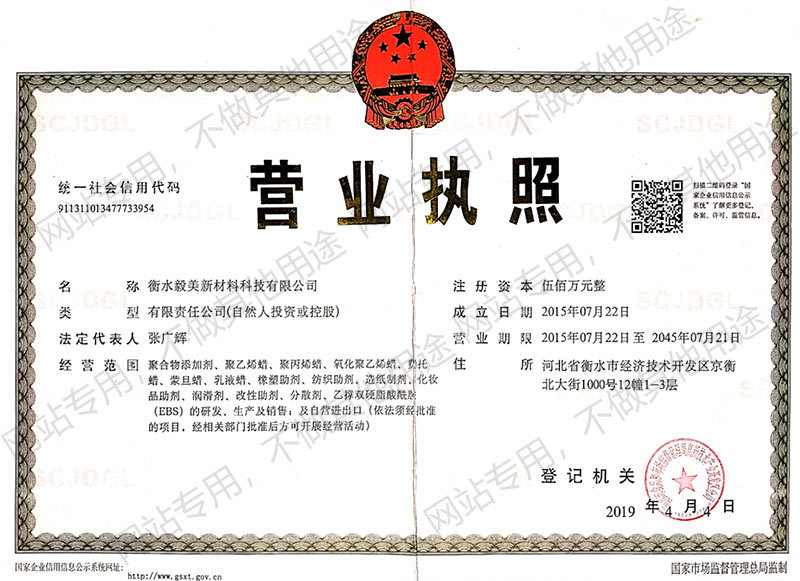
About UsHengshui yi mei new material technology co., ltd. was founded in 2015, is a collection of product development, production, sales and service as one of the high and new technology enterprises, yi mei company focused on deep processing of wax products, determined to become china's professional wax products supplier

-
ProductsThe company mainly produces and sells: polyethylene wax, oxidized polyethylene wax, synthetic Fischer-Tropsch wax, oxidized Fischer-Tropsch wax, maleic anhydride grafted wax, polypropylene wax, micro-powder wax, high-end composite wax and other eight series of dozens of models of high quality products.
-
NewsAt the beginning of its establishment, Yimei Company invested in the establishment of the "Polymer Additive R & D Center", insisting on scientific and technological innovation as the life force of enterprise development. Concentrate funds, technology, and talents in the company's scientific and technological innovation activities, focus on scientific research, public relations and technological breakthroughs of new products, new technologies, and new processes, and resolutely master core technologies.
-
SupportAt the beginning of its establishment, Yimei Company invested in the establishment of the "Polymer Additive R & D Center", insisting on scientific and technological innovation as the life force of enterprise development. Concentrate funds, technology, and talents in the company's scientific and technological innovation activities, focus on scientific research, public relations and technological breakthroughs of new products, new technologies, and new processes, and resolutely master core technologies.
-
RecruitmentOur company always adheres to the talent concept of "people-oriented", actively creates an atmosphere of respect, understanding, integrity and friendship, respects people's knowledge and talents, selects and develops mechanisms, and provides a growth platform for talents. make talents become a strong support for the sustainable development of enterprises, and realize the common growth and development of enterprises and talents.


OPE Wax: Revolutionizing the Chemical Formulation Landscape
Release time:
2024-09-01
OPE Wax: A Game Changer for the Chemical Formulation Sector Table of Contents 1. Introduction to OPE Wax and Its Importance 2. What is OPE Wax? 3. Benefits of Using OPE Wax in Chemical Formulations 4. Diverse Applications of OPE Wax in Different Industries 5. How OPE Wax Works in Formulations 6. Choosing the Right OPE Wax for Your Needs 7. Sustainability and Environmental Impact of OPE Wax 8. The
OPE Wax: A Game Changer for the Chemical Formulation Sector
Table of Contents
- 1. Introduction to OPE Wax and Its Importance
- 2. What is OPE Wax?
- 3. Benefits of Using OPE Wax in Chemical Formulations
- 4. Diverse Applications of OPE Wax in Different Industries
- 5. How OPE Wax Works in Formulations
- 6. Choosing the Right OPE Wax for Your Needs
- 7. Sustainability and Environmental Impact of OPE Wax
- 8. The Future of OPE Wax in Chemical Formulations
- 9. FAQs About OPE Wax
- 10. Conclusion
1. Introduction to OPE Wax and Its Importance
In the evolving landscape of the chemical formulation sector, OPE wax has emerged as a **revolutionary ingredient**. As manufacturers continually strive to enhance product performance, OPE wax stands out for its unique properties and versatility. This article delves into the many facets of OPE wax, demonstrating its significance and the transformative role it plays in diverse applications.
2. What is OPE Wax?
OPE Wax, or **Octadecyl Phosphate Ester Wax**, is a synthetic wax derived from the reaction of fatty acids and phosphate esters. Its unique molecular structure contributes to a range of valuable properties, making it an essential ingredient in various chemical formulations. OPE wax is recognized for its **excellent thermal stability, low viscosity, and outstanding lubricity**, which facilitates improved processing and end-product performance.
3. Benefits of Using OPE Wax in Chemical Formulations
The incorporation of OPE wax into chemical formulations offers a plethora of benefits:
Enhanced Surface Properties
OPE wax significantly improves surface characteristics, providing a smooth finish and enhanced gloss. This property is particularly invaluable in coatings, inks, and cosmetic formulations, where visual appeal is paramount.
Improved Processability
When used in formulations, OPE wax facilitates easier processing. Its **low melting point** and excellent flow properties allow for easier mixing and application, reducing production times and costs.
Increased Stability
The thermal stability of OPE wax allows products to maintain their integrity even under extreme conditions. This ensures that formulations remain effective and do not degrade over time.
Lubrication and Slip Properties
OPE wax provides **superior lubricity**, which minimizes friction during processing and application. This characteristic leads to improved machinery efficiency and reduced wear and tear, ultimately enhancing the lifespan of equipment.
4. Diverse Applications of OPE Wax in Different Industries
The versatility of OPE wax allows it to be utilized in a variety of industries, each benefiting from its unique properties.
Coatings and Paints
In the coatings industry, OPE wax enhances the **surface finish and durability** of paints, providing a protective barrier against environmental factors. Its ability to reduce surface tension results in better adhesion and leveling properties.
Cosmetics and Personal Care
OPE wax is widely used in cosmetics, imparting a luxurious feel to formulations. It helps in creating smooth textures in creams and lotions, improving spreadability and skin adhesion.
Adhesives and Sealants
In adhesive formulations, OPE wax improves the **bonding strength** and overall performance of products. Its low viscosity allows for better application characteristics, ensuring a strong, lasting bond.
Plastics and Polymers
OPE wax is used as a lubricant in plastic processing, reducing friction between materials and enhancing the flow of polymers during manufacturing. This leads to better-quality products with fewer defects.
5. How OPE Wax Works in Formulations
Understanding the mechanism of OPE wax within various formulations is crucial for maximizing its benefits. OPE wax operates through several key functions:
Dispersing Agent
OPE wax acts as an excellent dispersing agent, ensuring that pigments and fillers are evenly distributed throughout the formulation. This results in uniform color and consistency, critical for product quality.
Emulsifying Agent
In emulsions, OPE wax stabilizes the mixture of oil and water, preventing separation. This property is particularly important in creams and lotions, where a stable emulsion is necessary for effectiveness.
Plasticizer
The inclusion of OPE wax acts as a plasticizer, enhancing the flexibility and durability of the final product. This is crucial in applications where flexibility is required, such as in films and coatings.
6. Choosing the Right OPE Wax for Your Needs
Selecting the appropriate OPE wax involves considering several factors:
Formulation Requirements
Evaluate the specific requirements of your formulation, including desired properties such as viscosity, stability, and performance needs.
Compatibility with Other Ingredients
Ensure that the chosen OPE wax is compatible with other components in the formulation to prevent adverse reactions and optimize performance.
Cost and Availability
Consider budget constraints and the availability of the selected OPE wax in your region to ensure a smooth procurement process.
7. Sustainability and Environmental Impact of OPE Wax
Sustainability is a growing concern in the chemical formulation sector. OPE wax is often derived from renewable sources, making it a more environmentally friendly option compared to traditional waxes. Its use can contribute to reducing the overall carbon footprint of products. Furthermore, the efficient processing properties of OPE wax can lead to **less waste** during manufacturing, aligning with sustainable practices.
8. The Future of OPE Wax in Chemical Formulations
As the chemical formulation sector continues to evolve, the future of OPE wax looks promising. Ongoing research and development efforts aim to enhance its properties further and expand its applications. The increasing demand for sustainable and high-performance formulations will likely drive innovation in OPE wax, making it a key ingredient in future products.
9. FAQs About OPE Wax
What is OPE Wax used for?
OPE wax is used in various applications, including coatings, adhesives, cosmetics, and plastics, primarily for its excellent surface properties and processability.
Is OPE Wax safe for use in cosmetics?
Yes, OPE wax is generally considered safe for use in cosmetics and personal care products. However, it is essential to adhere to regulatory guidelines.
Can OPE Wax improve the shelf life of products?
Yes, due to its thermal stability and ability to enhance product durability, OPE wax can contribute to prolonged shelf life.
How does OPE Wax compare to other waxes?
OPE wax distinguishes itself with unique properties such as lower viscosity and better lubricity, which can outperform traditional waxes in certain applications.
Is OPE Wax environmentally friendly?
OPE wax can be derived from renewable sources, making it a more sustainable option compared to many synthetic waxes. Its efficient processing also contributes to reduced environmental impact.
10. Conclusion
In conclusion, OPE wax is undoubtedly a **game changer** in the chemical formulation sector. Its unique properties not only enhance product performance but also align with the industry's growing emphasis on sustainability and efficiency. As manufacturers continue to seek innovative solutions, OPE wax will play an increasingly pivotal role in driving advancements across various applications. Embracing the benefits of OPE wax can lead to superior formulations, satisfied consumers, and a more sustainable future.
Key words:
OPE wax
recommend reading