Yimei New Material-Professional Wax Product Solution Supplier


-
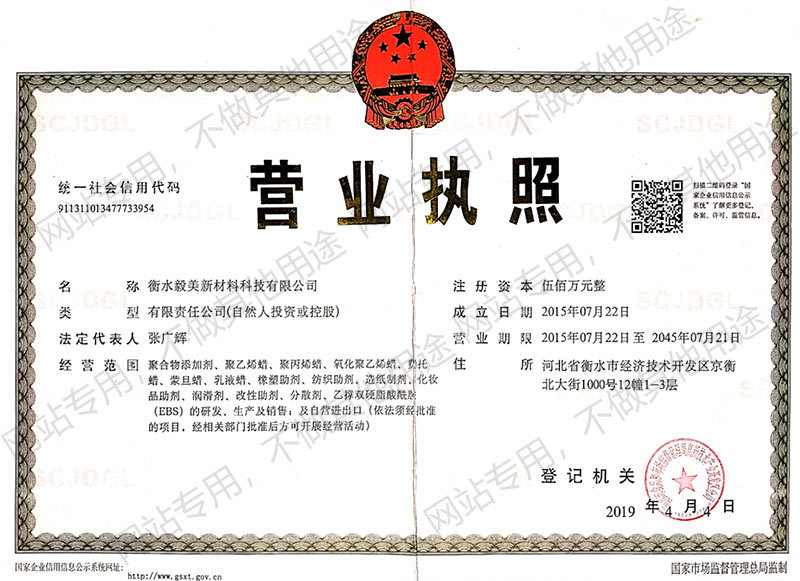
About UsHengshui yi mei new material technology co., ltd. was founded in 2015, is a collection of product development, production, sales and service as one of the high and new technology enterprises, yi mei company focused on deep processing of wax products, determined to become china's professional wax products supplier

-
ProductsThe company mainly produces and sells: polyethylene wax, oxidized polyethylene wax, synthetic Fischer-Tropsch wax, oxidized Fischer-Tropsch wax, maleic anhydride grafted wax, polypropylene wax, micro-powder wax, high-end composite wax and other eight series of dozens of models of high quality products.
-
NewsAt the beginning of its establishment, Yimei Company invested in the establishment of the "Polymer Additive R & D Center", insisting on scientific and technological innovation as the life force of enterprise development. Concentrate funds, technology, and talents in the company's scientific and technological innovation activities, focus on scientific research, public relations and technological breakthroughs of new products, new technologies, and new processes, and resolutely master core technologies.
-
SupportAt the beginning of its establishment, Yimei Company invested in the establishment of the "Polymer Additive R & D Center", insisting on scientific and technological innovation as the life force of enterprise development. Concentrate funds, technology, and talents in the company's scientific and technological innovation activities, focus on scientific research, public relations and technological breakthroughs of new products, new technologies, and new processes, and resolutely master core technologies.
-
RecruitmentOur company always adheres to the talent concept of "people-oriented", actively creates an atmosphere of respect, understanding, integrity and friendship, respects people's knowledge and talents, selects and develops mechanisms, and provides a growth platform for talents. make talents become a strong support for the sustainable development of enterprises, and realize the common growth and development of enterprises and talents.


Why Choose High Density Polyethylene Wax for Your Manufacturing Needs?
Release time:
2024-08-30
Why Choose High Density Polyethylene Wax for Your Manufacturing Needs? When it comes to optimizing manufacturing processes, the choice of materials can significantly impact the quality and efficiency of the final product. One material that has garnered attention in various industrial applications is High Density Polyethylene Wax (HDPE Wax). Its unique properties make it a versatile choice for enha
Why Choose High Density Polyethylene Wax for Your Manufacturing Needs?
When it comes to optimizing manufacturing processes, the choice of materials can significantly impact the quality and efficiency of the final product. One material that has garnered attention in various industrial applications is High Density Polyethylene Wax (HDPE Wax). Its unique properties make it a versatile choice for enhancing performance across multiple sectors. In this article, we delve into the benefits, applications, and technical specifications of HDPE Wax, illustrating why it should be your go-to material in manufacturing.
Table of Contents
- 1. Introduction to High Density Polyethylene Wax
- 2. Properties of High Density Polyethylene Wax
- 3. Applications of HDPE Wax in Manufacturing
- 4. Key Benefits of Using HDPE Wax
- 5. HDPE Wax vs. Other Waxes
- 6. Sustainability Aspects of HDPE Wax
- 7. Conclusion
- 8. Frequently Asked Questions about HDPE Wax
1. Introduction to High Density Polyethylene Wax
High Density Polyethylene Wax is a type of wax derived from polymerized polyethylene. It is known for its high molecular weight and low viscosity, which contribute to its excellent lubricating properties. This wax is primarily used in various manufacturing sectors, including plastics, coatings, inks, and even cosmetics. Understanding the chemical composition and physical characteristics of HDPE Wax helps manufacturers leverage its advantages to improve their products.
2. Properties of High Density Polyethylene Wax
The properties of HDPE Wax are what set it apart from other materials. Here are some key characteristics:
2.1 Chemical Resistance
HDPE Wax exhibits remarkable chemical resistance, making it suitable for use in harsh environments where exposure to chemicals is common. This property is essential for ensuring product longevity and stability.
2.2 Low Melting Point
With a low melting point, HDPE Wax can be easily processed and integrated into various formulations, including coatings and plastics. This feature allows manufacturers to enhance application efficiency.
2.3 High Lubricity
The excellent lubricating properties of HDPE Wax reduce friction between surfaces, improving the processing of materials in manufacturing. This characteristic is particularly valuable in the production of plastics and films.
2.4 Thermal Stability
HDPE Wax maintains its stability across a wide temperature range, ensuring that the properties of the end product are not compromised during processing or application.
3. Applications of HDPE Wax in Manufacturing
HDPE Wax is utilized in various applications across multiple industries:
3.1 Plastics Industry
In the plastics sector, HDPE Wax serves as a processing aid, enhancing the flow properties of the material and improving the surface finish of molded parts. It is especially useful in applications involving injection molding and extrusion.
3.2 Coatings
In the coatings industry, HDPE Wax is used to improve the durability and scratch resistance of paints and coatings. Its incorporation enhances the overall performance of the product, making it suitable for demanding applications.
3.3 Inks and Printing
HDPE Wax is also utilized in ink formulations, providing better adhesion and gloss. It enhances the physical properties of inks, ensuring high-quality printing results.
3.4 Cosmetics and Personal Care
With its safe and non-toxic nature, HDPE Wax finds applications in cosmetics and personal care products. It acts as a thickener and stabilizer, improving product texture and user experience.
4. Key Benefits of Using HDPE Wax
Integrating HDPE Wax into your manufacturing processes provides numerous advantages:
4.1 Enhanced Product Performance
By using HDPE Wax, manufacturers can achieve superior performance in their products. Its lubricating properties improve efficiency, while its chemical resistance ensures durability.
4.2 Cost-Effectiveness
While high-quality materials may come with a price, HDPE Wax often proves to be cost-effective in the long run due to reduced waste and enhanced processing efficiency.
4.3 Versatility
The versatility of HDPE Wax allows it to be used in a wide range of formulations, making it suitable for various industries and applications.
4.4 Improved Aesthetics
The addition of HDPE Wax can enhance the aesthetic qualities of products, providing better gloss and smooth finishes that appeal to consumers.
5. HDPE Wax vs. Other Waxes
When choosing a wax for manufacturing, it is essential to understand how HDPE Wax compares to other options:
5.1 HDPE Wax vs. Paraffin Wax
HDPE Wax offers better thermal stability and lubricity compared to paraffin wax, making it a superior choice for demanding applications. Paraffin wax is more prone to degradation under high temperatures.
5.2 HDPE Wax vs. Microcrystalline Wax
Microcrystalline wax may offer similar properties; however, HDPE Wax is favored for its higher melting point and ease of processing, making it more versatile in applications.
5.3 HDPE Wax vs. Carnauba Wax
While carnauba wax is sourced naturally, HDPE Wax provides consistent quality and performance, which is critical in industrial applications where reliability is paramount.
6. Sustainability Aspects of HDPE Wax
As industries strive for more sustainable practices, HDPE Wax stands out due to its recyclable nature. Being derived from polyethylene, it can be recycled and reused, minimizing waste and the environmental impact associated with manufacturing. Additionally, many manufacturers are developing eco-friendly formulations that incorporate HDPE Wax, further enhancing its appeal in a market leaning toward sustainability.
7. Conclusion
High Density Polyethylene Wax plays a crucial role in enhancing manufacturing processes across various industries. Its unique properties, including chemical resistance, low melting point, and high lubricity, make it an indispensable material for improving product performance. As companies continue to prioritize efficiency, cost-effectiveness, and sustainability, the importance of HDPE Wax will only grow. By choosing HDPE Wax for your manufacturing needs, you are making a decision that not only enhances your product quality but also aligns with sustainable practices that can benefit the environment.
8. Frequently Asked Questions about HDPE Wax
8.1 What is HDPE Wax made from?
HDPE Wax is derived from polymerized polyethylene, which is a thermoplastic polymer known for its high molecular weight and unique properties.
8.2 Can HDPE Wax be recycled?
Yes, HDPE Wax is recyclable, which makes it an environmentally friendly option for various applications and industries.
8.3 How does HDPE Wax improve the performance of coatings?
HDPE Wax enhances durability, scratch resistance, and overall aesthetic qualities of coatings, making them more effective in demanding environments.
8.4 Is HDPE Wax safe for use in cosmetics?
Yes, HDPE Wax is considered safe for use in cosmetics and personal care products, acting as a stabilizer and thickener without harmful effects.
8.5 What industries can benefit from using HDPE Wax?
Industries such as plastics, coatings, inks, and cosmetics can significantly benefit from the use of HDPE Wax, improving product quality and efficiency.
Key words:
high density polyethylene wax
Previous article
recommend reading