Yimei New Material-Professional Wax Product Solution Supplier


-
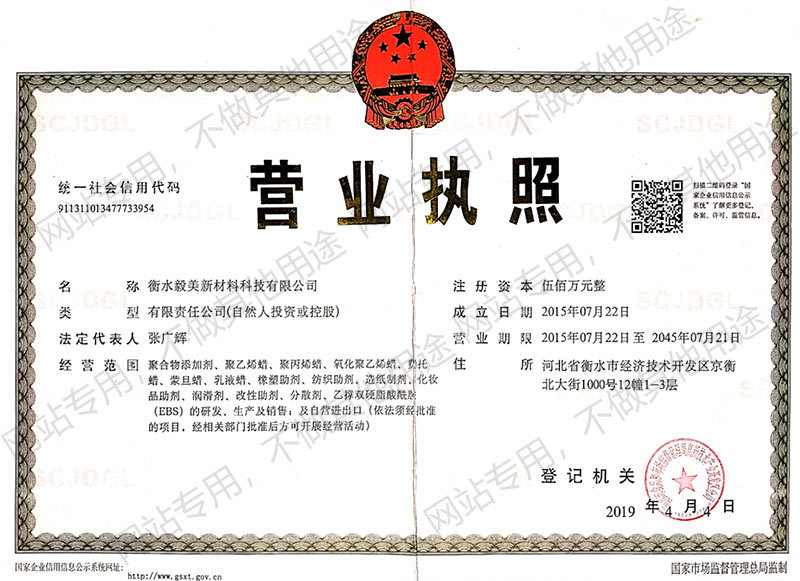
About UsHengshui yi mei new material technology co., ltd. was founded in 2015, is a collection of product development, production, sales and service as one of the high and new technology enterprises, yi mei company focused on deep processing of wax products, determined to become china's professional wax products supplier

-
ProductsThe company mainly produces and sells: polyethylene wax, oxidized polyethylene wax, synthetic Fischer-Tropsch wax, oxidized Fischer-Tropsch wax, maleic anhydride grafted wax, polypropylene wax, micro-powder wax, high-end composite wax and other eight series of dozens of models of high quality products.
-
NewsAt the beginning of its establishment, Yimei Company invested in the establishment of the "Polymer Additive R & D Center", insisting on scientific and technological innovation as the life force of enterprise development. Concentrate funds, technology, and talents in the company's scientific and technological innovation activities, focus on scientific research, public relations and technological breakthroughs of new products, new technologies, and new processes, and resolutely master core technologies.
-
SupportAt the beginning of its establishment, Yimei Company invested in the establishment of the "Polymer Additive R & D Center", insisting on scientific and technological innovation as the life force of enterprise development. Concentrate funds, technology, and talents in the company's scientific and technological innovation activities, focus on scientific research, public relations and technological breakthroughs of new products, new technologies, and new processes, and resolutely master core technologies.
-
RecruitmentOur company always adheres to the talent concept of "people-oriented", actively creates an atmosphere of respect, understanding, integrity and friendship, respects people's knowledge and talents, selects and develops mechanisms, and provides a growth platform for talents. make talents become a strong support for the sustainable development of enterprises, and realize the common growth and development of enterprises and talents.


Exploring the Role of Low Density Polyethylene Wax in Plastic Processing: A Comprehensive Guide
Release time:
2024-08-20
Exploring the Role of Low Density Polyethylene Wax in Plastic Processing Table of Contents 1. Introduction to Low-Density Polyethylene Wax 2. Properties of Low-Density Polyethylene Wax 3. Applications of LDPE Wax in Plastic Processing 3.1 LDPE Wax as an Additive 3.2 Use in Coatings and Films 3.3 Role in Masterbatches 4. Benefit
Exploring the Role of Low Density Polyethylene Wax in Plastic Processing
Table of Contents
- 1. Introduction to Low-Density Polyethylene Wax
- 2. Properties of Low-Density Polyethylene Wax
- 3. Applications of LDPE Wax in Plastic Processing
- 4. Benefits of Using LDPE Wax in Processing
- 5. Environmental Impact and Sustainability
- 6. Choosing the Right LDPE Wax Supplier
- 7. Frequently Asked Questions (FAQs)
- 8. Conclusion
1. Introduction to Low-Density Polyethylene Wax
Low-Density Polyethylene (LDPE) wax is a versatile polymer that plays a pivotal role in various plastic processing applications. Renowned for its low viscosity and excellent lubricating properties, LDPE wax has become a preferred choice among engineers and manufacturers. As the demand for advanced materials in the plastic industry grows, understanding the intricacies of LDPE wax is essential for optimizing production processes and enhancing product quality.
2. Properties of Low-Density Polyethylene Wax
LDPE wax is characterized by several unique properties that distinguish it from other waxes and polymers. These properties include:
2.1 Low Viscosity
The low viscosity of LDPE wax allows it to blend seamlessly with various plastic formulations, ensuring uniform distribution and ease of processing.
2.2 High Thermal Stability
Its thermal stability ensures that LDPE wax maintains its properties even under high-temperature processing conditions, making it ideal for extrusion and injection molding applications.
2.3 Excellent Lubrication
LDPE wax provides superior lubrication, reducing friction during processing. This property is particularly beneficial in enhancing the flow characteristics of plastics.
2.4 Compatibility with Other Polymers
LDPE wax is compatible with a wide range of polymers, including polyethylene, polypropylene, and polystyrene. This compatibility allows for tailored formulations to meet specific performance requirements.
3. Applications of LDPE Wax in Plastic Processing
LDPE wax finds a plethora of applications in plastic processing, greatly enhancing the performance and efficiency of various products.
3.1 LDPE Wax as an Additive
Incorporating LDPE wax as an additive in plastic formulations significantly enhances the processing characteristics. It helps to improve the flow properties, reduce melt viscosity, and increase the overall efficiency of the manufacturing process. As a result, plastic products exhibit improved surface finish and reduced defects.
3.2 Use in Coatings and Films
LDPE wax is widely used in coatings and films due to its excellent barrier properties and ability to enhance gloss and smoothness. It is often utilized in the production of packaging materials, where protection against moisture and oxygen is essential for extending shelf life.
3.3 Role in Masterbatches
Masterbatches are concentrated mixtures of pigments or additives encapsulated in a carrier resin. LDPE wax is commonly used in the production of masterbatches to enhance compatibility and dispersion of additives within the plastic matrix. This results in more vibrant colors and improved performance characteristics.
4. Benefits of Using LDPE Wax in Processing
Using LDPE wax in plastic processing brings numerous benefits, including:
4.1 Enhanced Processing Efficiency
LDPE wax reduces processing times by improving the melt flow index of polymers and decreasing energy consumption during manufacturing.
4.2 Improved Product Quality
The incorporation of LDPE wax leads to smoother surfaces, better gloss, and overall improved aesthetic appeal of end products.
4.3 Reduction in Production Costs
By optimizing processing conditions and reducing defects, LDPE wax contributes to lower production costs, allowing manufacturers to remain competitive in the market.
5. Environmental Impact and Sustainability
As the chemical industry pivots towards sustainability, LDPE wax plays a role in this transition.
5.1 Biodegradability
While LDPE wax is derived from petrochemical sources, its potential for biodegradability in certain conditions presents opportunities for developing more sustainable plastic products.
5.2 Recycling Compatibility
LDPE wax is compatible with recycling processes, allowing plastic products containing this wax to be recycled more efficiently, thereby reducing environmental impact.
5.3 Reducing Carbon Footprint
By improving processing efficiency and reducing waste, LDPE wax contributes to a lower carbon footprint in the manufacturing of plastic products.
6. Choosing the Right LDPE Wax Supplier
Selecting a reliable supplier for LDPE wax is crucial for achieving optimal results in plastic processing. Here are some factors to consider:
6.1 Quality and Purity
Ensure that the supplier offers high-quality LDPE wax with consistent purity levels to maintain the performance of your plastic formulations.
6.2 Technical Support
A supplier that provides technical support can be invaluable in optimizing processing conditions and resolving any issues that may arise.
6.3 Shipping and Delivery
Consider suppliers that offer timely shipping and delivery services to avoid production delays.
7. Frequently Asked Questions (FAQs)
7.1 What is LDPE wax used for?
LDPE wax is primarily used as an additive in plastic processing to enhance flow properties, improve surface finish, and increase processing efficiency.
7.2 Is LDPE wax biodegradable?
While LDPE wax is derived from petrochemical sources, it has potential for biodegradability under certain conditions, which can contribute to more sustainable plastic products.
7.3 Can LDPE wax be recycled?
Yes, LDPE wax is compatible with recycling processes, allowing for the efficient recycling of plastic products that contain it.
7.4 How does LDPE wax improve processing efficiency?
LDPE wax improves processing efficiency by reducing melt viscosity, enhancing flow characteristics, and ultimately decreasing energy consumption during manufacturing.
7.5 What are the main advantages of using LDPE wax in plastic formulations?
The main advantages include enhanced processing efficiency, improved product quality, and reduced production costs, making it an essential component in modern plastic processing.
8. Conclusion
Low-Density Polyethylene wax is a key player in the field of plastic processing, offering numerous advantages that enhance production efficiency and product quality. Its unique properties, diverse applications, and environmental benefits make it a vital component in the manufacturing of various plastic products. By understanding the role of LDPE wax, industry professionals can make informed decisions, optimizing their processes and contributing to a more sustainable future in the chemical industry.
Key words:
low density polyethylene wax
recommend reading