Yimei New Material-Professional Wax Product Solution Supplier


-
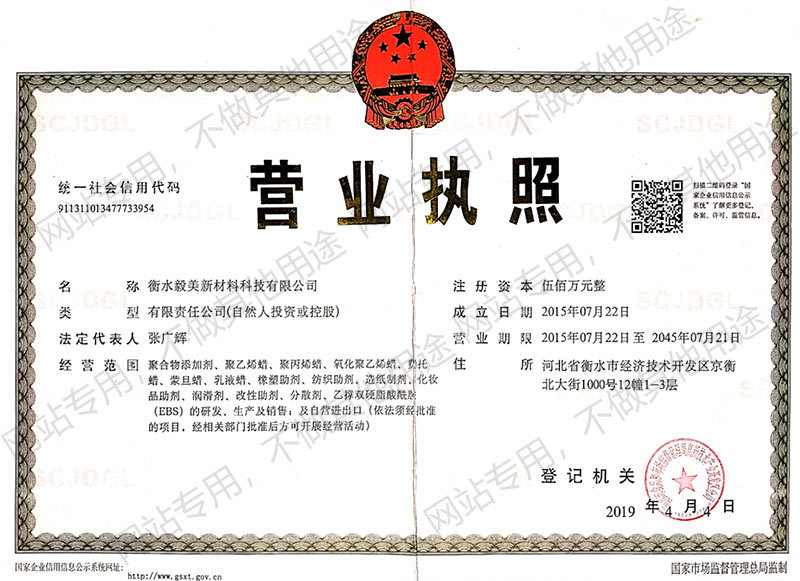
About UsHengshui yi mei new material technology co., ltd. was founded in 2015, is a collection of product development, production, sales and service as one of the high and new technology enterprises, yi mei company focused on deep processing of wax products, determined to become china's professional wax products supplier

-
ProductsThe company mainly produces and sells: polyethylene wax, oxidized polyethylene wax, synthetic Fischer-Tropsch wax, oxidized Fischer-Tropsch wax, maleic anhydride grafted wax, polypropylene wax, micro-powder wax, high-end composite wax and other eight series of dozens of models of high quality products.
-
NewsAt the beginning of its establishment, Yimei Company invested in the establishment of the "Polymer Additive R & D Center", insisting on scientific and technological innovation as the life force of enterprise development. Concentrate funds, technology, and talents in the company's scientific and technological innovation activities, focus on scientific research, public relations and technological breakthroughs of new products, new technologies, and new processes, and resolutely master core technologies.
-
SupportAt the beginning of its establishment, Yimei Company invested in the establishment of the "Polymer Additive R & D Center", insisting on scientific and technological innovation as the life force of enterprise development. Concentrate funds, technology, and talents in the company's scientific and technological innovation activities, focus on scientific research, public relations and technological breakthroughs of new products, new technologies, and new processes, and resolutely master core technologies.
-
RecruitmentOur company always adheres to the talent concept of "people-oriented", actively creates an atmosphere of respect, understanding, integrity and friendship, respects people's knowledge and talents, selects and develops mechanisms, and provides a growth platform for talents. make talents become a strong support for the sustainable development of enterprises, and realize the common growth and development of enterprises and talents.


Exploring the Journey of PVC Resin SG7: From Manufacturing to Practical Applications
Release time:
2024-06-19
**Introduction** PVC Resin SG7, also known as suspension grade polyvinyl chloride, is a widely used synthetic polymer that plays a crucial role in various industries. In this article, we will explore the journey of PVC Resin SG7, from its production in manufacturing plants to its diverse applications in everyday life. **The Production Process** The production of PVC Resin SG7 begins with the polym
**Introduction**
PVC Resin SG7, also known as suspension grade polyvinyl chloride, is a widely used synthetic polymer that plays a crucial role in various industries. In this article, we will explore the journey of PVC Resin SG7, from its production in manufacturing plants to its diverse applications in everyday life.
**The Production Process**
The production of PVC Resin SG7 begins with the polymerization of vinyl chloride monomers. This process typically takes place in a suspension polymerization reactor, where the monomers are suspended in water and react with initiators to form polymer chains. The resulting PVC Resin SG7 is then processed further to achieve the desired properties and molecular weight.
**Key Properties of PVC Resin SG7**
PVC Resin SG7 is known for its excellent chemical resistance, durability, and versatility. It can be easily molded into various shapes and sizes, making it ideal for a wide range of applications. Additionally, PVC Resin SG7 is highly cost-effective and offers excellent electrical insulation properties.
**Applications of PVC Resin SG7**
PVC Resin SG7 is used in a multitude of industries, including construction, automotive, healthcare, and packaging. In the construction sector, PVC Resin SG7 is commonly used for pipes, fittings, and profiles due to its high strength and corrosion resistance. In the automotive industry, PVC Resin SG7 is utilized for interior and exterior components, such as dashboards and bumpers.
**Environmental Considerations**
While PVC Resin SG7 offers numerous benefits, it is important to consider its environmental impact. PVC Resin SG7 is not biodegradable and can release toxic chemicals when burned. However, advancements in recycling technologies have made it possible to recycle PVC Resin SG7 and reduce its environmental footprint.
**FAQs**
1. What is PVC Resin SG7?
2. How is PVC Resin SG7 produced?
3. What are the key properties of PVC Resin SG7?
4. What are the main applications of PVC Resin SG7?
5. What are the environmental considerations of using PVC Resin SG7?
**Conclusion**
In conclusion, PVC Resin SG7 is a versatile material that plays a vital role in numerous industries. From its production in manufacturing plants to its diverse applications in everyday life, PVC Resin SG7 continues to be a valuable asset for various sectors. By understanding the journey of PVC Resin SG7, we can appreciate the significance of this synthetic polymer in our modern world.
PVC Resin SG7, also known as suspension grade polyvinyl chloride, is a widely used synthetic polymer that plays a crucial role in various industries. In this article, we will explore the journey of PVC Resin SG7, from its production in manufacturing plants to its diverse applications in everyday life.
**The Production Process**
The production of PVC Resin SG7 begins with the polymerization of vinyl chloride monomers. This process typically takes place in a suspension polymerization reactor, where the monomers are suspended in water and react with initiators to form polymer chains. The resulting PVC Resin SG7 is then processed further to achieve the desired properties and molecular weight.
**Key Properties of PVC Resin SG7**
PVC Resin SG7 is known for its excellent chemical resistance, durability, and versatility. It can be easily molded into various shapes and sizes, making it ideal for a wide range of applications. Additionally, PVC Resin SG7 is highly cost-effective and offers excellent electrical insulation properties.
**Applications of PVC Resin SG7**
PVC Resin SG7 is used in a multitude of industries, including construction, automotive, healthcare, and packaging. In the construction sector, PVC Resin SG7 is commonly used for pipes, fittings, and profiles due to its high strength and corrosion resistance. In the automotive industry, PVC Resin SG7 is utilized for interior and exterior components, such as dashboards and bumpers.
**Environmental Considerations**
While PVC Resin SG7 offers numerous benefits, it is important to consider its environmental impact. PVC Resin SG7 is not biodegradable and can release toxic chemicals when burned. However, advancements in recycling technologies have made it possible to recycle PVC Resin SG7 and reduce its environmental footprint.
**FAQs**
1. What is PVC Resin SG7?
2. How is PVC Resin SG7 produced?
3. What are the key properties of PVC Resin SG7?
4. What are the main applications of PVC Resin SG7?
5. What are the environmental considerations of using PVC Resin SG7?
**Conclusion**
In conclusion, PVC Resin SG7 is a versatile material that plays a vital role in numerous industries. From its production in manufacturing plants to its diverse applications in everyday life, PVC Resin SG7 continues to be a valuable asset for various sectors. By understanding the journey of PVC Resin SG7, we can appreciate the significance of this synthetic polymer in our modern world.
Key words:
PVC Resin SG7
recommend reading