Yimei New Material-Professional Wax Product Solution Supplier


-
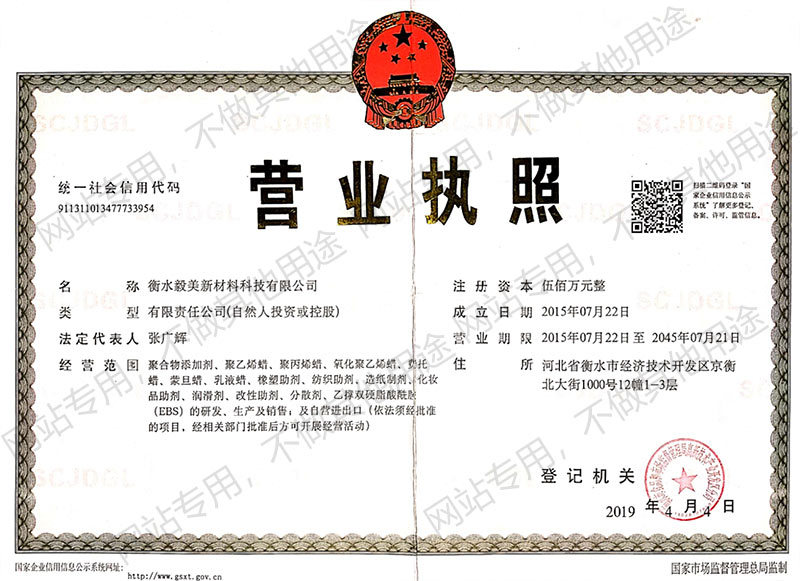
About UsHengshui yi mei new material technology co., ltd. was founded in 2015, is a collection of product development, production, sales and service as one of the high and new technology enterprises, yi mei company focused on deep processing of wax products, determined to become china's professional wax products supplier

-
ProductsThe company mainly produces and sells: polyethylene wax, oxidized polyethylene wax, synthetic Fischer-Tropsch wax, oxidized Fischer-Tropsch wax, maleic anhydride grafted wax, polypropylene wax, micro-powder wax, high-end composite wax and other eight series of dozens of models of high quality products.
-
NewsAt the beginning of its establishment, Yimei Company invested in the establishment of the "Polymer Additive R & D Center", insisting on scientific and technological innovation as the life force of enterprise development. Concentrate funds, technology, and talents in the company's scientific and technological innovation activities, focus on scientific research, public relations and technological breakthroughs of new products, new technologies, and new processes, and resolutely master core technologies.
-
SupportAt the beginning of its establishment, Yimei Company invested in the establishment of the "Polymer Additive R & D Center", insisting on scientific and technological innovation as the life force of enterprise development. Concentrate funds, technology, and talents in the company's scientific and technological innovation activities, focus on scientific research, public relations and technological breakthroughs of new products, new technologies, and new processes, and resolutely master core technologies.
-
RecruitmentOur company always adheres to the talent concept of "people-oriented", actively creates an atmosphere of respect, understanding, integrity and friendship, respects people's knowledge and talents, selects and develops mechanisms, and provides a growth platform for talents. make talents become a strong support for the sustainable development of enterprises, and realize the common growth and development of enterprises and talents.


Understanding the Production Process of Honeywell Micronized Wax: A Comprehensive Guide for Industry Professionals
Release time:
2023-12-28
Table of Contents 1. Introduction 2. Raw Material Selection and Preparation 3. Micronization Process 3.1 Grinding and Milling 3.2 Particle Size Analysis 4. Wax Modification Techniques 4.1 Chemical Modification 4.2 Physical Modification 5. Formulation and Blending 5.1 Wax Properties Consideration 5.2 Compatibility Testing 6. Quality Control Measures 6.1 Testing and Analysis
1. Introduction
2. Raw Material Selection and Preparation
3. Micronization Process
3.1 Grinding and Milling
3.2 Particle Size Analysis
4. Wax Modification Techniques
4.1 Chemical Modification
4.2 Physical Modification
5. Formulation and Blending
5.1 Wax Properties Consideration
5.2 Compatibility Testing
6. Quality Control Measures
6.1 Testing and Analysis
6.2 Compliance with Industry Standards
7. Applications of Honeywell Micronized Wax
7.1 Coating Industry
7.2 Adhesive Industry
7.3 Plastic Industry
7.4 Printing Ink Industry
7.5 Other Industries
8. Frequently Asked Questions (FAQs)
8.1 What is Honeywell Micronized Wax?
8.2 How is Honeywell Micronized Wax produced?
8.3 What are the advantages of using Honeywell Micronized Wax?
8.4 Are there any safety precautions while handling Honeywell Micronized Wax?
8.5 Can Honeywell Micronized Wax be used in food-grade applications?
9. Conclusion
1. Introduction
The production process of Honeywell Micronized Wax involves a series of carefully executed steps to ensure the creation of a high-quality product. This article aims to provide a comprehensive guide for industry professionals, outlining the key stages and considerations involved in producing Honeywell Micronized Wax.
2. Raw Material Selection and Preparation
To achieve optimal results, the selection of raw materials is crucial. Honeywell carefully sources high-quality raw materials that meet specific requirements. These materials undergo rigorous quality checks and are prepared for further processing.
3. Micronization Process
The micronization process plays a vital role in obtaining the desired particle size distribution of the wax. This section explores the two primary steps involved: grinding and milling, and particle size analysis.
3.1 Grinding and Milling
During grinding and milling, the raw materials are processed to reduce their particle size. This step enhances the melt point, rheological properties, and overall performance of the wax.
3.2 Particle Size Analysis
Accurate and consistent particle size distribution is crucial in achieving the desired characteristics of Honeywell Micronized Wax. Particle size analysis techniques are employed to ensure precise control over the final product's properties.
4. Wax Modification Techniques
Wax modification techniques are employed to tailor the properties of Honeywell Micronized Wax to specific application requirements. This section delves into two primary methods: chemical modification and physical modification.
4.1 Chemical Modification
Chemical modification involves introducing specific compounds or additives to alter the wax's properties. This technique allows for customization, enhancing attributes such as hardness, adhesion, and compatibility.
4.2 Physical Modification
Physical modification techniques focus on altering the wax's physical structure and morphology. This approach allows for modifications in properties like particle size, surface area, and crystallinity.
5. Formulation and Blending
Formulation and blending processes ensure the creation of tailored wax compositions suitable for various applications. Two crucial aspects, wax properties consideration and compatibility testing, are explored in this section.
5.1 Wax Properties Consideration
Formulating a wax composition involves considering specific properties like melting point, viscosity, and hardness to meet the desired application requirements. Thorough analysis and understanding of these properties are imperative.
5.2 Compatibility Testing
Compatibility testing is essential to determine the compatibility of the formulated wax composition with other ingredients or substances commonly used in the application. This step ensures optimal performance and stability.
6. Quality Control Measures
Maintaining consistent and superior product quality is of utmost importance in the production of Honeywell Micronized Wax. This section sheds light on the testing and analysis procedures and the adherence to industry standards.
6.1 Testing and Analysis
Various rigorous testing and analysis methods are employed throughout the production process to assess the wax's quality. These include tests for particle size, melt point, viscosity, and other critical parameters.
6.2 Compliance with Industry Standards
Honeywell meticulously follows industry standards and regulations to ensure the production of high-quality Micronized Wax. Compliance with these standards guarantees the safety and reliability of the end products.
7. Applications of Honeywell Micronized Wax
Honeywell Micronized Wax finds extensive application across diverse industries. This section highlights its utilization in the coating, adhesive, plastic, printing ink, and other industries.
7.1 Coating Industry
Honeywell Micronized Wax enhances coating formulations by improving scratch resistance, slip properties, and abrasion resistance. It finds applications in automotive coatings, furniture polishes, and more.
7.2 Adhesive Industry
In the adhesive industry, Honeywell Micronized Wax serves as a crucial ingredient, providing benefits like improved tack, reduced friction, and enhanced peel strength. It is widely used in hot melts, pressure-sensitive adhesives, and sealants.
7.3 Plastic Industry
The plastic industry utilizes Honeywell Micronized Wax as a processing aid, offering benefits like reduced melt viscosity, improved mold release, and enhanced surface finish. It finds applications in various plastic processing techniques.
7.4 Printing Ink Industry
Honeywell Micronized Wax acts as a performance-enhancing additive in printing inks. It aids in improving rub resistance, gloss, anti-blocking properties, and printability.
7.5 Other Industries
Apart from the aforementioned industries, Honeywell Micronized Wax finds applications in diverse sectors such as agriculture, textiles, and personal care, contributing to improved product performance and functionality.
8. Frequently Asked Questions (FAQs)
8.1 What is Honeywell Micronized Wax?
Honeywell Micronized Wax is a chemical compound widely used in various industries. It offers unique properties and benefits, making it suitable for several applications.
8.2 How is Honeywell Micronized Wax produced?
The production of Honeywell Micronized Wax involves a series of well-defined steps, including raw material selection, micronization, wax modification, formulation, and quality control measures.
8.3 What are the advantages of using Honeywell Micronized Wax?
Honeywell Micronized Wax offers numerous advantages, including improved performance, enhanced functionality, and customized properties for specific applications.
8.4 Are there any safety precautions while handling Honeywell Micronized Wax?
Yes, like any other chemical compound, proper safety precautions should be followed while handling Honeywell Micronized Wax. These may include wearing protective equipment and ensuring adequate ventilation.
8.5 Can Honeywell Micronized Wax be used in food-grade applications?
Honeywell Micronized Wax is not typically used in food-grade applications. However, it is always recommended to consult the manufacturer or an expert for specific requirements.
9. Conclusion
In conclusion, understanding the production process of Honeywell Micronized Wax is vital for industry professionals seeking comprehensive knowledge of this versatile chemical compound. With careful raw material selection, precise micronization techniques, effective wax modification, and quality control measures, Honeywell ensures the production of high-quality Micronized Wax that finds applications across various industries. By following industry standards and regulations, Honeywell maintains its commitment to delivering excellence in performance and functionality.
Key words:
Honeywell micronized wax conpanies
Previous article
recommend reading