Yimei New Material-Professional Wax Product Solution Supplier


-
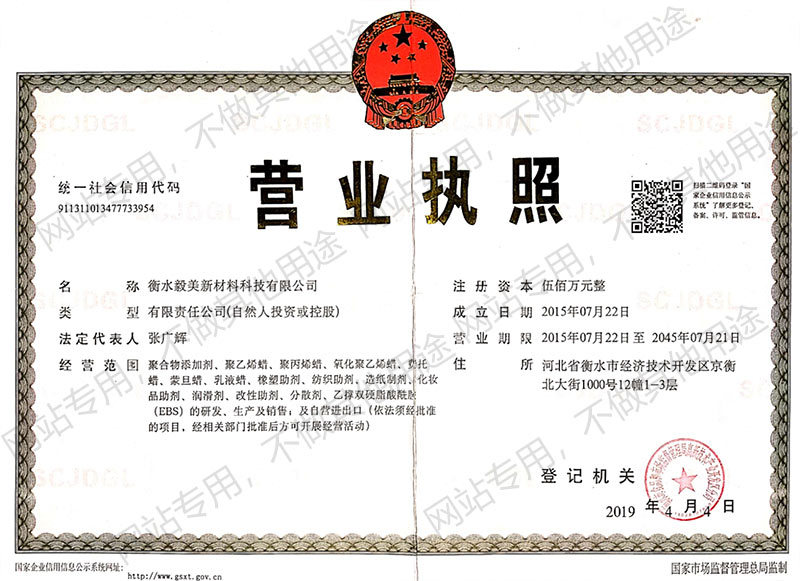
About UsHengshui yi mei new material technology co., ltd. was founded in 2015, is a collection of product development, production, sales and service as one of the high and new technology enterprises, yi mei company focused on deep processing of wax products, determined to become china's professional wax products supplier

-
ProductsThe company mainly produces and sells: polyethylene wax, oxidized polyethylene wax, synthetic Fischer-Tropsch wax, oxidized Fischer-Tropsch wax, maleic anhydride grafted wax, polypropylene wax, micro-powder wax, high-end composite wax and other eight series of dozens of models of high quality products.
-
NewsAt the beginning of its establishment, Yimei Company invested in the establishment of the "Polymer Additive R & D Center", insisting on scientific and technological innovation as the life force of enterprise development. Concentrate funds, technology, and talents in the company's scientific and technological innovation activities, focus on scientific research, public relations and technological breakthroughs of new products, new technologies, and new processes, and resolutely master core technologies.
-
SupportAt the beginning of its establishment, Yimei Company invested in the establishment of the "Polymer Additive R & D Center", insisting on scientific and technological innovation as the life force of enterprise development. Concentrate funds, technology, and talents in the company's scientific and technological innovation activities, focus on scientific research, public relations and technological breakthroughs of new products, new technologies, and new processes, and resolutely master core technologies.
-
RecruitmentOur company always adheres to the talent concept of "people-oriented", actively creates an atmosphere of respect, understanding, integrity and friendship, respects people's knowledge and talents, selects and develops mechanisms, and provides a growth platform for talents. make talents become a strong support for the sustainable development of enterprises, and realize the common growth and development of enterprises and talents.

Maleic Anhydride Grafting on PE/PP Wax: Exploring the Process in China
Release time:
2023-12-05
Table of Contents 1. Introduction 2. Understanding Maleic Anhydride Grafting 3. The Significance of PE/PP Wax 4. The Process of Maleic Anhydride Grafting on PE/PP Wax 5. Applications of Maleic Anhydride Grafted PE/PP Wax in China 6. Frequently Asked Questions (FAQs) 7. Conclusion 1. Introduction Maleic anhydride grafting on PE/PP wax is a fascinating process that has gained significant traction in
Table of Contents
1. Introduction
2. Understanding Maleic Anhydride Grafting
3. The Significance of PE/PP Wax
4. The Process of Maleic Anhydride Grafting on PE/PP Wax
5. Applications of Maleic Anhydride Grafted PE/PP Wax in China
6. Frequently Asked Questions (FAQs)
7. Conclusion
Maleic anhydride grafting on PE/PP wax is a fascinating process that has gained significant traction in China's chemical industry. By enhancing the properties of PE/PP wax, this technique has revolutionized various applications, ranging from coatings and adhesives to lubricants and plastics. In this article, we will explore the intricacies of this process and its impact on China's chemical landscape.
Maleic anhydride grafting is a chemical reaction that involves the attachment of maleic anhydride molecules onto the surface of PE/PP wax. This reaction modifies the properties of the wax, making it more versatile and useful in several industries. By introducing polar groups through grafting, the wax becomes compatible with a broader range of materials, leading to improved adhesion, dispersion, and compatibility.
PE/PP wax, also known as polyethylene/polypropylene wax, is a widely used material in various industries due to its unique properties. It offers excellent lubrication, heat resistance, and processing stability, making it an ideal additive or processing aid in many applications. However, the inherent non-polar nature of PE/PP wax limits its compatibility with polar materials. Maleic anhydride grafting addresses this limitation and expands the possibilities for its utilization.
The process of maleic anhydride grafting on PE/PP wax involves several steps, each crucial for achieving optimal results. Initially, the PE/PP wax is heated to a specific temperature, ensuring its molten state. Then, maleic anhydride is added gradually to the melted wax while stirring vigorously. This allows the anhydride molecules to react with the surface of the wax, forming the desired grafting bonds. The reaction is typically catalyzed by peroxides or other initiators, ensuring the grafting occurs effectively. Finally, the maleic anhydride grafted PE/PP wax is cooled and solidified, ready for further applications.
Maleic anhydride grafted PE/PP wax finds extensive use in various industries across China. Its enhanced compatibility and unique properties make it a valuable component in coatings, adhesives, and sealants. The wax acts as an effective dispersant, improving the viscosity and stability of coatings. Additionally, it enhances adhesion properties, ensuring durable and long-lasting bonds. In the plastic industry, maleic anhydride grafted PE/PP wax acts as a processing aid, reducing friction during molding processes and enhancing the surface finish of plastic products. Moreover, it finds applications in the formulation of lubricants, where its excellent heat resistance and lubricating properties provide optimal performance.
1. How does maleic anhydride grafting improve the properties of PE/PP wax?
2. What are the key advantages of using maleic anhydride grafted PE/PP wax in coatings?
3. Can maleic anhydride grafted PE/PP wax be used in high-temperature applications?
4. Are there any safety considerations when handling maleic anhydride grafting on PE/PP wax?
5. What are the environmental benefits associated with maleic anhydride grafted PE/PP wax?
In conclusion, maleic anhydride grafting on PE/PP wax has revolutionized the chemical industry in China. By enhancing the properties of PE/PP wax through this process, it has opened up new possibilities and applications. From coatings and adhesives to plastics and lubricants, maleic anhydride grafted PE/PP wax offers improved compatibility, adhesion, and performance. As China continues to excel in the field of chemical engineering, this process will undoubtedly play a vital role in shaping the industry's future.
1. Introduction
2. Understanding Maleic Anhydride Grafting
3. The Significance of PE/PP Wax
4. The Process of Maleic Anhydride Grafting on PE/PP Wax
5. Applications of Maleic Anhydride Grafted PE/PP Wax in China
6. Frequently Asked Questions (FAQs)
7. Conclusion
1. Introduction
Maleic anhydride grafting on PE/PP wax is a fascinating process that has gained significant traction in China's chemical industry. By enhancing the properties of PE/PP wax, this technique has revolutionized various applications, ranging from coatings and adhesives to lubricants and plastics. In this article, we will explore the intricacies of this process and its impact on China's chemical landscape.
2. Understanding Maleic Anhydride Grafting
Maleic anhydride grafting is a chemical reaction that involves the attachment of maleic anhydride molecules onto the surface of PE/PP wax. This reaction modifies the properties of the wax, making it more versatile and useful in several industries. By introducing polar groups through grafting, the wax becomes compatible with a broader range of materials, leading to improved adhesion, dispersion, and compatibility.
3. The Significance of PE/PP Wax
PE/PP wax, also known as polyethylene/polypropylene wax, is a widely used material in various industries due to its unique properties. It offers excellent lubrication, heat resistance, and processing stability, making it an ideal additive or processing aid in many applications. However, the inherent non-polar nature of PE/PP wax limits its compatibility with polar materials. Maleic anhydride grafting addresses this limitation and expands the possibilities for its utilization.
4. The Process of Maleic Anhydride Grafting on PE/PP Wax
The process of maleic anhydride grafting on PE/PP wax involves several steps, each crucial for achieving optimal results. Initially, the PE/PP wax is heated to a specific temperature, ensuring its molten state. Then, maleic anhydride is added gradually to the melted wax while stirring vigorously. This allows the anhydride molecules to react with the surface of the wax, forming the desired grafting bonds. The reaction is typically catalyzed by peroxides or other initiators, ensuring the grafting occurs effectively. Finally, the maleic anhydride grafted PE/PP wax is cooled and solidified, ready for further applications.
5. Applications of Maleic Anhydride Grafted PE/PP Wax in China
Maleic anhydride grafted PE/PP wax finds extensive use in various industries across China. Its enhanced compatibility and unique properties make it a valuable component in coatings, adhesives, and sealants. The wax acts as an effective dispersant, improving the viscosity and stability of coatings. Additionally, it enhances adhesion properties, ensuring durable and long-lasting bonds. In the plastic industry, maleic anhydride grafted PE/PP wax acts as a processing aid, reducing friction during molding processes and enhancing the surface finish of plastic products. Moreover, it finds applications in the formulation of lubricants, where its excellent heat resistance and lubricating properties provide optimal performance.
6. Frequently Asked Questions (FAQs)
1. How does maleic anhydride grafting improve the properties of PE/PP wax?
2. What are the key advantages of using maleic anhydride grafted PE/PP wax in coatings?
3. Can maleic anhydride grafted PE/PP wax be used in high-temperature applications?
4. Are there any safety considerations when handling maleic anhydride grafting on PE/PP wax?
5. What are the environmental benefits associated with maleic anhydride grafted PE/PP wax?
7. Conclusion
In conclusion, maleic anhydride grafting on PE/PP wax has revolutionized the chemical industry in China. By enhancing the properties of PE/PP wax through this process, it has opened up new possibilities and applications. From coatings and adhesives to plastics and lubricants, maleic anhydride grafted PE/PP wax offers improved compatibility, adhesion, and performance. As China continues to excel in the field of chemical engineering, this process will undoubtedly play a vital role in shaping the industry's future.
Key words:
China maleic anhydride grafted PE/PP wax exporters
recommend reading